FORT BONIFACIO, Taguig City - For two senior leaders of the Philippine Army, achieving success as a professional soldier and as a family man is possible.
Colonel Arthur Ang, the current Brigade Commander of the Army’s 901st Infantry Brigade, and Chief Master Sergeant Guillermo Francisco, the Army’s Command Sergeant Major, said that military service and family life should go hand in hand.
Both 51, they believe that a soldier can’t afford to be successful in one and a failure on the other. Failing in one would be personally devastating. These two fathers take pride in being successful in both worlds.
For his part, Ang firmly believes that there is no value of having a successful military career but having a broken or dysfunctional family.
“The good news is that winning in both fronts is achievable. Failure in one is never an option; hence, finding the right balance is paramount. The key lies on the understanding, cooperation, and having a common direction towards proper molding of the children. ” explained Ang.
Meanwhile, Francisco’s secret formula for a successful marriage is not simply communication but consistent communication. He said that this requires extra efforts for the soldier and his wife.
“Even before the popularity of the cellular phones and the internet, I never failed to consistently communicate to my wife and children as part of my responsibility as the leader of my the family. I‘m well aware that coming short to my obligation as a father would have a negative impact to the well-being of my family.” he said.
‘No time for Love’
During the early days of their military career, Army soldiers are normally sent to the frontlines for their combat duties. Naturally, adventurous and young soldiers are the workhorses of the Philippine Army in its counter-insurgency operations and other tasks.
As a young and adventurous lieutenant who wanted a piece of real action, Ang started his military career fighting the secessionist rebels in Basilan island as a Platoon Leader of the 45th Infantry Battalion in 1981.
After a year, he found himself scaling the mountain ranges of Luzon when his unit was redeployed to confront the growing influence of the communist terrorists there.
“Due to the demands of my combat assignment, I rarely met my parents and my wife, Evangeline, who was still my girlfriend during that time. Since I was still single in the first four years of my military service, I focused on performing my job well as a company grade officer and learning other tradecrafts as much as I can.” revealed Ang.
On the other hand , Francisco, trained as an elite Scout Ranger, scoured the hinterlands of the Visayas islands as a young Private of the Army’s Special Warfare Brigade in the early 80‘s.
When he was assigned with the Army’s rapid deployment force, the First Scout Ranger Regiment (FSRR), he found himself hopping from one island to another, widening his forays to the enemy’s heartland in Mindanao and the lush forests of the Sierra Madre mountain ranges.
“In the FSRR, I had practically no time for love. At duty’s call, we get to deploy from one place to another in a moment’s notice. Soldiery became my first love and my rifle as my wife!” said Francisco as he laughed. “In the first twelve years of my career, I was single. It was in 1983 that I married my beloved wife Annielyn.“
Communicating with the Family
While carrying out their jobs in the military, both Ang and Francisco tried their best in performing their other important role - as a husband and as a father. They have placed high value to family despite the time-demanding and financially-constraining military profession.
They both believe that effective communication is the best remedy for their absence from home and other family predicaments.
Ang said that establishing constant communication with his family has been a habit for him. He said that the lack of postal service in Basilan in the early 80’s did not hinder him to maintain his constant contact with his wife.
“I wrote my love letters using ‘palara’ (cigarette pack) then sent it through any of my soldier who is about to go on leave in Luzon,” he narrated fondly.
With no advanced technological gadget that could deliver real-time communication, the military tactical radio set became the preferred mode of communication among soldiers and their families during that period. The ultra-high frequency (UHF) radio, the URC 187, became the ever precious link between soldiers and their loved ones. Though connecting both ends using the said radio is cumbersome, it nonetheless served its purpose and made everyone happy even for a moment.
Ang said that his wife availed of this communication line through his Unit liaison office in Fort Bonifacio.
Franciso likewise said that the same equipment had served as the main link to his family during his deployment to distant posts.
“Through the wonders of that superb equipment, we were able to talk even when I was in the boondocks and away from civilization. Can you imagine how it felt hearing the voice of your beloved after weeks, or even months, in the jungle?” said Francisco as he reminisce it with a smile.
The advent of the cellular phone in the military in mid-90s gave the soldiers the ability to reach their loved ones much easier and in an instant. Their family members don’t need to go to nearby camps and queue for a few hours to avail of free calls using the URC187 radio.
Ang, while undergoing a specialization training in Australia, spent much of his allowances on phone cards. He virtually burnt the lines chatting with his wife and only son, sharing their respective experiences.
Similarly, through his own cellular phone, Francisco continuously performed his role as a father even when he was in the hinterlands of Basilan sometime in 2002. “I helped my children with their school homework through text messages and phone calls. I helped them solve the problems then relay the answers through text messages,” he narrated with a wide grin.
The military father
Both wives of Ang and Francisco quit their respective jobs in order to dedicate themselves as full-time housewives.
“My wife abandoned her career to look after our son 24/7. We knew from the very start that it would mean financial difficulty but our son’s welfare and correct upbringing was our top priority,” Ang resolutely said.
Francisco ably convinced his wife to quit her job by the time their eldest child, Angeline, was born. He didn’t want to follow other soldiers who chose to tag along their families even in far-flung military detachments.
“I wanted my children to be personally reared by their mother in a family-friendly community while I was far away. I delegated most of my fatherly duties to my wife and I was lucky that she performed them very well. My wife is one tough cookie, she is a mother who can truly enforce order in our household. I’m truly fortunate to have her as my wife.” Francisco said warmheartedly.
Being constantly away from home, military children are normally closer to their mothers than their soldier-father.
Aware of this fact, Ang and his wife constantly remind their son about his father’s sacrifices in the service of the country and the nobility of the military profession. Through his wife, Ang ably remained as the father-figure in their son’s life despite his long absences.
Ang also believes that military fathers should not be too harsh on their children. Dealing with the kids is a bit tricky and can easily go haywire especially if they are treated as in a martial manner.
“As a father who is most of the time away from home, I cannot afford spending my limited time mistreating his son. I think that children who are mistreated by their soldier-father tend to become rebellious. Everytime I come home, I dedicate my time in our ‘bonding moments’ to create good memories about my presence,” Ang explained.
He further said that it is very important to maintain the ‘right balance’ and the role of the mother is crucial to the success of the household .
Golden moments
As an officer, there were times that Ang was designated to positions of major responsibility. During those times, going home became much more difficult.
“When I was a Battalion Commander in Bataan, my wife used to request that my son be allowed to take the written exams in advance so that they can spend time with me longer during school breaks,” he said. “Because I can’t go home to spend vacation, my family usually come to my headquarters in the field to stay with me for a week or two. We made necessary adjustments to maintain our excellent relationships”.
As an enlisted man, Francisco usually avail of the 15-day Rest and Recreation (R&R) privilege once every six months. When he was posted in remote assignments, it meant he can spend only about 10-days with his family taking into consideration the length of travel.
“Whenever I am home, I maximized my time with my wife and children. I used my limited time as an opportunity to make up with my absence by being with them all the time - watching TV shows, attending church services, and dining out. In our house, I transform from pure soldier to being jack-of-all-trades…being the carpenter who fixes whatever kinks in our house, a cook for my wife and kids, a nanny, an errand guy, a clown to make them laugh, etc. I did try my best to compensate for my absence. I kept telling myself, “I am a Scout Ranger, therefore I can do everything for the welfare of everybody especially for my family. Some may find it funny but it‘s true”, he said with a laugh.
When Ang was posted as a military attache in China, his family made a difficult choice. He convinced his son to temporarily quit his college studies in order to come with him to Beijing.
All that he wanted was to strengthen his relationship with his son. He noticed that he was closer to his mom and that he was drifting away from him
“Despite the fact that I am not a stranger to him, my son tend to confide to his mother. He turns to her for his financial requirements and other personal issues. In one way or another, I ‘envy’ my wife so I decided to bring them along with me in my new assignment,” said Ang.
Our stay in Beijing was probably the best time in our lives. For three years, we lived normally as one happy family - dining together, strolling around, and watching movies.
“My son became my ‘barkada’ (best friend) due to this assignment. It is priceless and I owe it to my military service,” Ang confided.
Winning in both fronts
Among military men, winning both in the home front and in their military career is an outstanding success.
“Knowing that my son has never been into any vice is already a big success for me. He has acquired the right attitude of a Filipino citizen and he never bragged about his soldier-father nor abuse his father's position,” Ang proudly said.
“I could not contain my happiness knowing that he has appreciated my military service and that he fully appreciate the sacrifices of our soldiers and their families in the service of our country. He never whined about my continuous absence. I owed everything to my loving and supportive wife, Evangeline,” Ang said.
Having simple dreams in life, Ang said that he has fulfilled his life’s aspirations. As a Brigade Commander, he would soon become a star-ranked officer.
“To become a General officer is already a bonus for me and I will repay our country with my honest and dedicated service until my retirement day in August 2015,” Ang humbly vowed.
Meanwhile, as the most ranking non-commissioned officer (NCO) in the Philippine Army, Francisco is in the pinnacle of his career. Having been recognized as one of the most respected NCO-leaders in the AFP, he is also an awardee of Metrobank and Rotary Club Makati-Metro’s The Outstanding Philippine Soldiers. Truly, he is an accomplished soldier.
Francisco is now busy doing some rounds to various Army field units and consulting with the soldiers while sharing his life’s valuable lessons.
Proud of his six well-disciplined children, Francisco said that they are his main accomplishments. He aims to motivate his fellow soldiers to follow his path.
“For the past years, I do not celebrate Father’s Day but I will this year. I will celebrate it by setting myself as an example that being a good soldier-father is very much possible. The dual role of being a father and a soldier is a challenge that we need to overcome and succeed. Yes, having a good career is rewarding but having a wonderful family is truly satisfying personally and spiritually. And to respectfully quote and modify few lines from George Skypeck‘s poem, “I was that which others did not want to be…I asked nothing from those who gave nothing. And reluctantly accepted the thought of eternal loneliness... should I fail. I have seen the face of terror; felt the stinging cold of fear; and enjoyed the sweet taste of a moment’s love. I have cried, pained, and hoped...but most of all, I have lived times others would say were best forgotten. At least someday, I will be able to say that I was proud of what I was...a soldier…and a good father to my family.” Francisco self-effacingly said in closing.
Showing posts with label Everyday Heroes. Show all posts
Showing posts with label Everyday Heroes. Show all posts
Wednesday, July 13, 2011

Wednesday, May 25, 2011
Army's DRO Teams Get Ready For TS Chedeng In Bicol Region
The following pictures were taken during the mustering of DRO assets in front of the Office of the Civil Defense 5 yesterday at 9:00am. It was participated by various government agencies such as the AFP, DPWH, PCG, BFP and the PNP. Governor Jose "Joey" Sarte Salceda gave 2 rubber boats to the 9th Infantry Division and 1 for the Philippine Coast Guard.
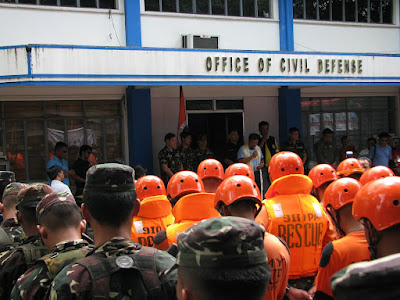
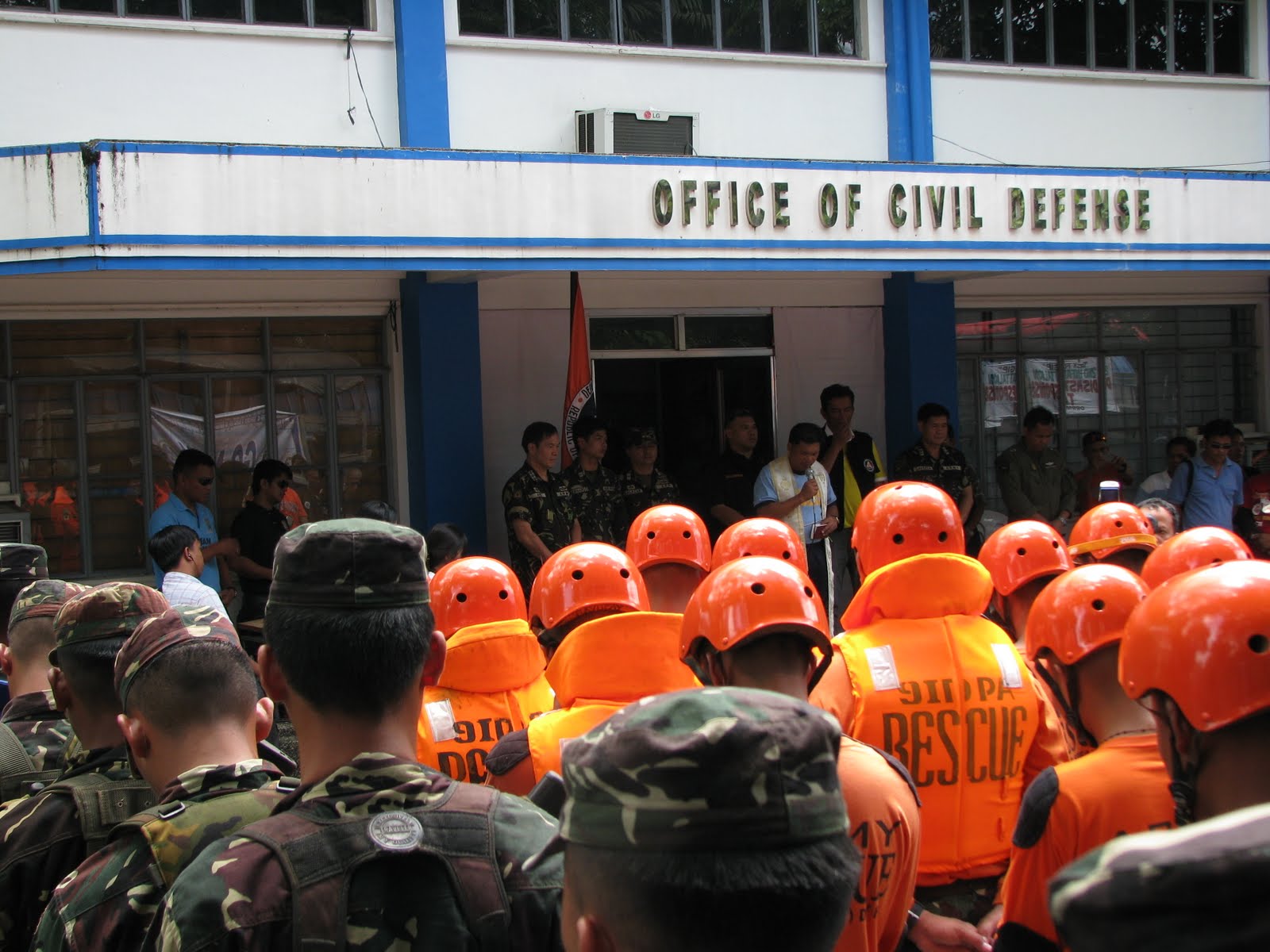
 COMMANDER'S BRIEFING. Colonel Arthur P Ang, Commander of the 901st Brigade of the Philippine Army, receives a unit briefing from the leader of the 9ID's Disaster Response Operations Team, 1st Lieutenant Ronnie Sicad, during the mustering of DRO assets in Legaspi City yesterday at 9:00am. (Photo by S7,901st Bde)
 DISASTER PREPAREDNESS. Albay's PDRRMC prepares for the coming of TS Chedeng in a joint disaster preparedness drills held in Camp Simeon Ola in Legaspi City yesterday at 9:00am. The activity was supervised by senior government officials including Governor Jose "Joey" Salceda, OCD5 Director Raffy Alejandro, 9ID Commander Major General Josue Gaverza Jr and 901st Brigade Commander Colonel Arthur Ang. (Photo by S7,901st Bde)
Tuesday, March 15, 2011
Soldiery and Family Life: Connecting the Two Different Worlds
by Major Harold M. Cabunoc (Inf) PA
Is it possible to be successful as a parent and as a military man? Quoting one of PMA’s plebe knowledge, “...this question is still languishing in my heart,” . I am aware that this is quite a challenge. As a married military man myself, I am finding ways to find some solutions.
Broken homes and failed marriages are becoming common among families separated by distance. This is applicable to both OFWs and soldiers who are separated from their loved ones.
In my research, I have not seen any document showing the statistics of troubled marriages among military couples. There are no also records about military dependents who became drug addicts or juvenile delinquents.
I can only assume that this ‘problem’ has not caught the attention of many military leaders. In my honest opinion, this maybe a reason why there is no institutionalized training or seminars for soldiers on how to perform their dual responsibilities as a soldier and as a family man.
Soldier’s Morale
Among military personnel, it is quite common to see spouses and children left behind in their homes as soldiers are deployed to distant posts.
While in far-flung duty assignments, many of these soldiers seem to have forgotten their responsibilities as husbands and fathers; they focus much of their time on their military duties.
The soldiers’ inability to maintain the lines of communication result to failed marriages and ill-supervised children, who may became drug addicts and juvenile delinquents in the future. I have known about successful military men who rose to become star-rank officers but failed miserably at the home front. I see this as a great failure on the part of the soldiers and probably of their leaders who have failed to see this reality.
In my own experience as a combat leader, I realized that a soldier’s morale is directly affected by the condition in his home. You cannot expect a soldier to focus on his job if he carries the burdens brought about by family-related woes.
As a leader, I am also affected by these problems. In one solid example, I sent home one of my soldiers when his Team Leader told me that the soldier was always staring at a ‘blank wall’. I traced his troubles back to his tumultuous family situation.
Aware of these, it became part of my personal commitment to look into the status of the families of my men. During Commander’s time, I never failed to remind them about their important role both as a father and as a husband, on top of their basic responsibilities as soldiers.
To ensure that I would not commit the same mistakes, I tried my best to address the same problem in my own family.
When my son, Harvey, was born eleven years ago, I realized that I could not perform all the ‘jobs’ of a father. He was born during the time that I was about to become a Commander of the 10th Scout Ranger Company, a rapid deployment force that could be sent anywhere in the Philippine archipelago.
I would not be there to teach him how to walk, or how to ride a bike, or how to fly a kite. I would not be there to help him in his school assignments or teach him how to cook.
Establishing the ‘connection’
Being new parents, my wife, Bia, and I relied heavily on folk wisdom or the ‘sabi-sabi’ as regards to the correct ways to maintain the bond between me and our son, Harvey.
“Maglagay kayo ng di nalabhang damit sa tabi ng bata,” was the advice from our baby-sitter.
“I read that a baby ‘connects’ through scent and not through vision,” my wife added, quoting some ideas she scanned from a book on responsible parenting. I readily agreed, hoping that it really works.
So there I was, bundling my unwashed shirt beside him when I departed for Sulu in September 2000, during the Sipadan hostage rescue operations. My son was about eight months old during that time. Pinagtitiisan nya ang aking amoy dahil nakasabit sa kanyang crib ang aking damit na di nilabhan. The unwashed shirt that I leave every time became his comfort blanket and his guardian.
While serving in the frontlines of the Army’s counter-terrorism campaign in southern Mindanao, I was quite thankful to the guys in Finland who invented the cellular phone.
I was also very happy that cellphone signal was very good in downtown Jolo where at least two thousand soldiers were deployed to simultaneously attack the terrorist lairs in Sulu province in September 2000.
As such, I always make it a point to make a phone call and make myself heard not only to my beloved wife, but also to our son during our resupply operations.
In one of our conversations, I can vividly recall when my wife said, “Tumatawa sya nang marinig ang boses mo, Dear.” I was happy that our techniques seemed to work perfectly.
That became my motivation to volunteer to climb some high grounds for ‘observation post’ (OP) operations because these hills offer good phone coverage as an incentive. Bud Tumatangis in Indanan town and the surrounding hills of Kagay and Tanum in Patikul are among the best places for making phone calls. Unfortunately, the bandits were aware of this too and some of our fierce clashes happened in these areas.
‘Tactical’ communications
I maintained the same system of communication with my family when my unit was transferred to Basilan during the Lamitan siege in June 2001. For this reason, I found out that there were strong phone signals on top of Hill 800 and Hill 898 (Punoh Mohadji).
When security situations permitted, I made it a personal routine to send my family text messages or phone calls when extremely necessary. Though I may be deep in the lush forests of Sampinit complex and within the lair of the terrorists, I maintained my communication lines to my family. I did not want them to be stressed, thinking about my situation.
It was also a stress-reliever for me to hear my son utter “Papa” as if greeting me or wishing me good luck.
As a policy, I did not tell her about the details of our military operations as this would make her worry some more. I just told her that we were ‘resting’ for a while and that my unit was doing fine. In one occasion, I told her we were all ‘okay’ despite the fact that I am still shaking and my unit just suffered numerous casualties (wounded) after a brutal encounter.
My wife had adjusted to the situation that I needed to talk in whispers every time I make a call in a ‘hot’ area. “Tactical considerations, let’s talk within 3-5 minutes,” I tell her.
Since clashes were always in the headlines during those times, I always made it a point to relay a message to my wife through military communication lines when cellphone signal cannot be accessed in my area of operations (AO).
“Tell her that I am alive and kicking the butts of the terrorists here,” I would joke to my radio operator in our camp in Cabunbata village in Isabela town. He would relay the same message to my wife through our unit’s cellphone.
It was my hope that my wife would not entertain thoughts that I might be one of the casualties in the bloody clashes. I was aware of the fact that the events in Basilan filled the primetime news and that the Scout Rangers were at the very forefront of the dangerous combat-rescue missions during those times.
During lull of the military operations, I also find time to fly to Manila to see my family even for only three days. To do this, I usually pay a round trip ticket (Zambo-Manila-Zambo) just to ensure that I can rejoin my company after its ‘rest period’ elapses. By doing so, I sustained the bonding moments with my wife and my son.
Consistency is the key
When I was transferred to Bulacan province for my staff duty assignment in May 2002, my son was already talkative and playful. He was barely three year old when I regularly hopped back and forth Manila and our headquarters in San Miguel town, located about 2.5 hours away from home.
When I am on duty, I saw to it that I talked to him everyday. Our phone conversations became part of my ‘duty’ that I religiously performed. “Papa, san ka? Bakit ka nandyan?” was his repeated dialogue. Parang sirang plaka sa mga tanong pero aking pinagtitiyagaang sagutin kahit paulit-ulit.
I had the opportunity to be with my family regularly when I was posted as a Liaison Officer in Fort Bonifacio in that same year. Unlike in the field, soldiers who are posted in garrisons usually have the chance to spend the weekends with their family. I therefore became one of the so-called ‘weekend warriors’.
As part of our bonding time, we regularly had swimming trips. He loved playing in the pool and I became his first
swimming instructor. Through our ‘habulan’ games, we created memories that would be imprinted forever in both our hearts.
Where is Papa?
When my son was five years old, saying goodbye became much more difficult. When I was detailed as an instructor in the Scout Ranger School, I always depart in the wee hours of the morning so that I can catch the start of the classes at 8:00am.
One morning, my wife called to tell me that Harvey was crying because I did not ask for his permission to leave the house. “I will wake you up next time son,” I promised him.
He took my word like a covenant. Since then, I always make it a point to get his nod every time I depart for duty. Most of the time, he was still too groggy to rise and send me off. However, I was glad that I did not hear more grumblings from him anymore.
Probably influenced by the negative impact of the primetime news about battles and tales of destruction in Mindanao, my son never liked soldiery as a profession. “Ayaw kong mamatay. Takot ako sa Abu Sayyaf,” were among his reasons. His mom could only nod in agreement.
I am glad that my duty as a company grade officer was over when he gradually became aware about the bloody battles in the countryside.
I believe Naomi Drew, author of Hope and Healing: Raising Peaceful Children in an Uncertain World when she said that children are usually terrified by the prospect of war and that this fear is magnified for those with family members in the armed forces.
I also agree when she declared that, “Children live by routines, such as eating dinner at a certain time or having a bedtime story read to them every night. These routines make them feel safe and in control. When a routine is broken—in this case, the absence of a parent for an unspecified period of time—a child may begin to feel helpless and adrift.”
I believe that it was the reason why he complained about my inability to ask for his permission before I depart for my military duty.
As my only child, he expected that that I am still beside him when he wakes up. He disliked the idea that I am not there to play with him the whole day.
Creating memories
Regardless of the constant phone calls from hundreds of miles away, I still felt that my son is becoming aloof to me as time went by. Definitely, there is no replacement for actual presence. As they say, ‘iba ang may pinagsamahan’. There are things that cannot be compensated by long distance conversations.
When I get the opportunity to go home, I always make it a point to spend quality time with my son. I identified some common interests that we have. When there are minor conflicts about what we like, we meet halfway and come up with compromises.
Since the three of us love Swedish massage, we find time to visit our favorite massage parlor. It has become a convenient way to share experiences and laughter especially when we compare the performance of our respective attendants.
We also implemented the family coffee time during which we just talk and share funny stories about our own lives. I share my ‘kwentong mess kit’, which is about the humor in uniform. Hearing the real life funny situations involving soldiers, I found out that he appreciates even simple jokes.
For his part, I require him to share his daily experiences as a child, about his crushes (which he reluctantly shares) and about his close friends.
We taught him the importance of honesty and the proper use of “All Right” challenge, which I learned in the PMA. Until now, he has adhered to his highest standard of integrity. He also takes note about the importance of word of honor. Lagi akong nasisingil kapag nakakalimutan ko ang sarili kong promises.
Lately, my son and I are into pistol shooting. Somehow, I influenced him after several shooting competitions during which I tagged him along as my cheerer. He is becoming a very good shooter now. Malapit na akong ma-demote bilang cheerer.
It started out when I told him that I ‘won’ many friends through shooting competitions. I asked him if he wants to do something for the country. “Gusto ko po,” came his reply.
I asked him if he wants to be an Olympic gold medalist in one of our ‘usapang mag-ama’ as we called our conversations. “You will become a national hero. Nobody has brought home a gold medal until today.”
Since then, I shared to him my shooting skills. Aware that shooting is quite expensive, he urged me at one point to concentrate on the coaching job. I soon realized it was a trick so that he can have all the ammunitions intended for both of us.
Naturally, shooting became our passion. Discussing his shooting ‘dry practices’ became part of our small talks every night. I told him to minimize playing computer games as this might adversely affect his vision. I also told him to undergo swimming and aerobic exercise, which he readily obliged. Dahil sa shooting, meron na kaming karagdagang pinag-uusapan.
I also noticed that our communication lines have become more open and less informal as it should be. He shares to me his feelings such as his ‘nerbiyos’ prior to an actual match; and I always ensured that I taught him the techniques to overcome them.
“Just concentrate on the shooting basics. Don’t think about the people watching you but think on how to shoot straight consistently all the time,” I reminded him.
When he won his first official shooting match in February 2011, he was very proud. He called me and asked me to take a photo of his trophy for his Face book account.I got a simple reward for my coaching job when I heard him say, “I am proud of my Coach Papa.”
Technological advancements
During my younger years as a Platoon Leader in mid 90’s, our soldiers were contented with the use of the URC 187 HF radio to talk with their loved ones. I can vividly recall soldiers saying, “I love you too, over!” to their wives who chatted with them through the military communication lines of another military camp near their homes.
When I was a Company Commander, majority of my soldiers had their own cellphones. I also maintained a company-owned cellphone that was monitored by our support personnel 24/7.
Those who had no personal cellphones were allowed to use the unit’s cellphone for emergency outgoing calls. I also required them to maintain communication lines to their loved ones and I personally write letters to their wives or parents. By doing so, I have helped save some troubled marriages in my unit.
With the advent of 3G video calls, Skype and Yahoo Messenger, maintaining the lines of communication is becoming much easier.
It seems that there are no more valid alibis left for soldiers not to maintain a robust relationship with their loved ones.
I can confidently say that we can be the best soldier and a responsible family man if we want to do it. We must strive to achieve this usually unrecognized ‘accomplishment’.
I had received many combat medals and citations in the past. Indeed, I am very proud for them.
But during my Basilan tour in 1998, I received my first “Best Husband” certificate from my wife. It made me prouder.
I am still waiting for my “Best Father” award from my son. I am still working hard for it. It will make me the proudest soldier.
***(This article is dedicated to all soldiers who have offered their lives in the service of the motherland)
Is it possible to be successful as a parent and as a military man? Quoting one of PMA’s plebe knowledge, “...this question is still languishing in my heart,” . I am aware that this is quite a challenge. As a married military man myself, I am finding ways to find some solutions.
Broken homes and failed marriages are becoming common among families separated by distance. This is applicable to both OFWs and soldiers who are separated from their loved ones.
In my research, I have not seen any document showing the statistics of troubled marriages among military couples. There are no also records about military dependents who became drug addicts or juvenile delinquents.
I can only assume that this ‘problem’ has not caught the attention of many military leaders. In my honest opinion, this maybe a reason why there is no institutionalized training or seminars for soldiers on how to perform their dual responsibilities as a soldier and as a family man.
Soldier’s Morale
Among military personnel, it is quite common to see spouses and children left behind in their homes as soldiers are deployed to distant posts.
While in far-flung duty assignments, many of these soldiers seem to have forgotten their responsibilities as husbands and fathers; they focus much of their time on their military duties.
The soldiers’ inability to maintain the lines of communication result to failed marriages and ill-supervised children, who may became drug addicts and juvenile delinquents in the future. I have known about successful military men who rose to become star-rank officers but failed miserably at the home front. I see this as a great failure on the part of the soldiers and probably of their leaders who have failed to see this reality.
In my own experience as a combat leader, I realized that a soldier’s morale is directly affected by the condition in his home. You cannot expect a soldier to focus on his job if he carries the burdens brought about by family-related woes.
As a leader, I am also affected by these problems. In one solid example, I sent home one of my soldiers when his Team Leader told me that the soldier was always staring at a ‘blank wall’. I traced his troubles back to his tumultuous family situation.
Aware of these, it became part of my personal commitment to look into the status of the families of my men. During Commander’s time, I never failed to remind them about their important role both as a father and as a husband, on top of their basic responsibilities as soldiers.
To ensure that I would not commit the same mistakes, I tried my best to address the same problem in my own family.
When my son, Harvey, was born eleven years ago, I realized that I could not perform all the ‘jobs’ of a father. He was born during the time that I was about to become a Commander of the 10th Scout Ranger Company, a rapid deployment force that could be sent anywhere in the Philippine archipelago.
I would not be there to teach him how to walk, or how to ride a bike, or how to fly a kite. I would not be there to help him in his school assignments or teach him how to cook.
Establishing the ‘connection’
Being new parents, my wife, Bia, and I relied heavily on folk wisdom or the ‘sabi-sabi’ as regards to the correct ways to maintain the bond between me and our son, Harvey.
“Maglagay kayo ng di nalabhang damit sa tabi ng bata,” was the advice from our baby-sitter.
“I read that a baby ‘connects’ through scent and not through vision,” my wife added, quoting some ideas she scanned from a book on responsible parenting. I readily agreed, hoping that it really works.
So there I was, bundling my unwashed shirt beside him when I departed for Sulu in September 2000, during the Sipadan hostage rescue operations. My son was about eight months old during that time. Pinagtitiisan nya ang aking amoy dahil nakasabit sa kanyang crib ang aking damit na di nilabhan. The unwashed shirt that I leave every time became his comfort blanket and his guardian.
While serving in the frontlines of the Army’s counter-terrorism campaign in southern Mindanao, I was quite thankful to the guys in Finland who invented the cellular phone.
I was also very happy that cellphone signal was very good in downtown Jolo where at least two thousand soldiers were deployed to simultaneously attack the terrorist lairs in Sulu province in September 2000.
As such, I always make it a point to make a phone call and make myself heard not only to my beloved wife, but also to our son during our resupply operations.
In one of our conversations, I can vividly recall when my wife said, “Tumatawa sya nang marinig ang boses mo, Dear.” I was happy that our techniques seemed to work perfectly.
That became my motivation to volunteer to climb some high grounds for ‘observation post’ (OP) operations because these hills offer good phone coverage as an incentive. Bud Tumatangis in Indanan town and the surrounding hills of Kagay and Tanum in Patikul are among the best places for making phone calls. Unfortunately, the bandits were aware of this too and some of our fierce clashes happened in these areas.
‘Tactical’ communications
I maintained the same system of communication with my family when my unit was transferred to Basilan during the Lamitan siege in June 2001. For this reason, I found out that there were strong phone signals on top of Hill 800 and Hill 898 (Punoh Mohadji).
When security situations permitted, I made it a personal routine to send my family text messages or phone calls when extremely necessary. Though I may be deep in the lush forests of Sampinit complex and within the lair of the terrorists, I maintained my communication lines to my family. I did not want them to be stressed, thinking about my situation.
It was also a stress-reliever for me to hear my son utter “Papa” as if greeting me or wishing me good luck.
As a policy, I did not tell her about the details of our military operations as this would make her worry some more. I just told her that we were ‘resting’ for a while and that my unit was doing fine. In one occasion, I told her we were all ‘okay’ despite the fact that I am still shaking and my unit just suffered numerous casualties (wounded) after a brutal encounter.
My wife had adjusted to the situation that I needed to talk in whispers every time I make a call in a ‘hot’ area. “Tactical considerations, let’s talk within 3-5 minutes,” I tell her.
Since clashes were always in the headlines during those times, I always made it a point to relay a message to my wife through military communication lines when cellphone signal cannot be accessed in my area of operations (AO).
“Tell her that I am alive and kicking the butts of the terrorists here,” I would joke to my radio operator in our camp in Cabunbata village in Isabela town. He would relay the same message to my wife through our unit’s cellphone.
It was my hope that my wife would not entertain thoughts that I might be one of the casualties in the bloody clashes. I was aware of the fact that the events in Basilan filled the primetime news and that the Scout Rangers were at the very forefront of the dangerous combat-rescue missions during those times.
During lull of the military operations, I also find time to fly to Manila to see my family even for only three days. To do this, I usually pay a round trip ticket (Zambo-Manila-Zambo) just to ensure that I can rejoin my company after its ‘rest period’ elapses. By doing so, I sustained the bonding moments with my wife and my son.
Consistency is the key
When I was transferred to Bulacan province for my staff duty assignment in May 2002, my son was already talkative and playful. He was barely three year old when I regularly hopped back and forth Manila and our headquarters in San Miguel town, located about 2.5 hours away from home.
When I am on duty, I saw to it that I talked to him everyday. Our phone conversations became part of my ‘duty’ that I religiously performed. “Papa, san ka? Bakit ka nandyan?” was his repeated dialogue. Parang sirang plaka sa mga tanong pero aking pinagtitiyagaang sagutin kahit paulit-ulit.
I had the opportunity to be with my family regularly when I was posted as a Liaison Officer in Fort Bonifacio in that same year. Unlike in the field, soldiers who are posted in garrisons usually have the chance to spend the weekends with their family. I therefore became one of the so-called ‘weekend warriors’.
As part of our bonding time, we regularly had swimming trips. He loved playing in the pool and I became his first
swimming instructor. Through our ‘habulan’ games, we created memories that would be imprinted forever in both our hearts.
Where is Papa?
When my son was five years old, saying goodbye became much more difficult. When I was detailed as an instructor in the Scout Ranger School, I always depart in the wee hours of the morning so that I can catch the start of the classes at 8:00am.
One morning, my wife called to tell me that Harvey was crying because I did not ask for his permission to leave the house. “I will wake you up next time son,” I promised him.
He took my word like a covenant. Since then, I always make it a point to get his nod every time I depart for duty. Most of the time, he was still too groggy to rise and send me off. However, I was glad that I did not hear more grumblings from him anymore.
Probably influenced by the negative impact of the primetime news about battles and tales of destruction in Mindanao, my son never liked soldiery as a profession. “Ayaw kong mamatay. Takot ako sa Abu Sayyaf,” were among his reasons. His mom could only nod in agreement.
I am glad that my duty as a company grade officer was over when he gradually became aware about the bloody battles in the countryside.
I believe Naomi Drew, author of Hope and Healing: Raising Peaceful Children in an Uncertain World when she said that children are usually terrified by the prospect of war and that this fear is magnified for those with family members in the armed forces.
I also agree when she declared that, “Children live by routines, such as eating dinner at a certain time or having a bedtime story read to them every night. These routines make them feel safe and in control. When a routine is broken—in this case, the absence of a parent for an unspecified period of time—a child may begin to feel helpless and adrift.”
I believe that it was the reason why he complained about my inability to ask for his permission before I depart for my military duty.
As my only child, he expected that that I am still beside him when he wakes up. He disliked the idea that I am not there to play with him the whole day.
Creating memories
Regardless of the constant phone calls from hundreds of miles away, I still felt that my son is becoming aloof to me as time went by. Definitely, there is no replacement for actual presence. As they say, ‘iba ang may pinagsamahan’. There are things that cannot be compensated by long distance conversations.
When I get the opportunity to go home, I always make it a point to spend quality time with my son. I identified some common interests that we have. When there are minor conflicts about what we like, we meet halfway and come up with compromises.
Since the three of us love Swedish massage, we find time to visit our favorite massage parlor. It has become a convenient way to share experiences and laughter especially when we compare the performance of our respective attendants.
We also implemented the family coffee time during which we just talk and share funny stories about our own lives. I share my ‘kwentong mess kit’, which is about the humor in uniform. Hearing the real life funny situations involving soldiers, I found out that he appreciates even simple jokes.
For his part, I require him to share his daily experiences as a child, about his crushes (which he reluctantly shares) and about his close friends.
We taught him the importance of honesty and the proper use of “All Right” challenge, which I learned in the PMA. Until now, he has adhered to his highest standard of integrity. He also takes note about the importance of word of honor. Lagi akong nasisingil kapag nakakalimutan ko ang sarili kong promises.
Lately, my son and I are into pistol shooting. Somehow, I influenced him after several shooting competitions during which I tagged him along as my cheerer. He is becoming a very good shooter now. Malapit na akong ma-demote bilang cheerer.
It started out when I told him that I ‘won’ many friends through shooting competitions. I asked him if he wants to do something for the country. “Gusto ko po,” came his reply.
I asked him if he wants to be an Olympic gold medalist in one of our ‘usapang mag-ama’ as we called our conversations. “You will become a national hero. Nobody has brought home a gold medal until today.”
Since then, I shared to him my shooting skills. Aware that shooting is quite expensive, he urged me at one point to concentrate on the coaching job. I soon realized it was a trick so that he can have all the ammunitions intended for both of us.
Naturally, shooting became our passion. Discussing his shooting ‘dry practices’ became part of our small talks every night. I told him to minimize playing computer games as this might adversely affect his vision. I also told him to undergo swimming and aerobic exercise, which he readily obliged. Dahil sa shooting, meron na kaming karagdagang pinag-uusapan.
I also noticed that our communication lines have become more open and less informal as it should be. He shares to me his feelings such as his ‘nerbiyos’ prior to an actual match; and I always ensured that I taught him the techniques to overcome them.
“Just concentrate on the shooting basics. Don’t think about the people watching you but think on how to shoot straight consistently all the time,” I reminded him.
When he won his first official shooting match in February 2011, he was very proud. He called me and asked me to take a photo of his trophy for his Face book account.I got a simple reward for my coaching job when I heard him say, “I am proud of my Coach Papa.”
Technological advancements
During my younger years as a Platoon Leader in mid 90’s, our soldiers were contented with the use of the URC 187 HF radio to talk with their loved ones. I can vividly recall soldiers saying, “I love you too, over!” to their wives who chatted with them through the military communication lines of another military camp near their homes.
When I was a Company Commander, majority of my soldiers had their own cellphones. I also maintained a company-owned cellphone that was monitored by our support personnel 24/7.
Those who had no personal cellphones were allowed to use the unit’s cellphone for emergency outgoing calls. I also required them to maintain communication lines to their loved ones and I personally write letters to their wives or parents. By doing so, I have helped save some troubled marriages in my unit.
With the advent of 3G video calls, Skype and Yahoo Messenger, maintaining the lines of communication is becoming much easier.
It seems that there are no more valid alibis left for soldiers not to maintain a robust relationship with their loved ones.
I can confidently say that we can be the best soldier and a responsible family man if we want to do it. We must strive to achieve this usually unrecognized ‘accomplishment’.
I had received many combat medals and citations in the past. Indeed, I am very proud for them.
But during my Basilan tour in 1998, I received my first “Best Husband” certificate from my wife. It made me prouder.
I am still waiting for my “Best Father” award from my son. I am still working hard for it. It will make me the proudest soldier.
***(This article is dedicated to all soldiers who have offered their lives in the service of the motherland)
Wednesday, February 23, 2011
Monday, February 21, 2011
2,000 People Evacuated as Bulusan Volcano Spews Ash Anew


JUBAN,Sorsogon – Two thousand affected residents around Mt Bulusan were evacuated after the latest ash explosion at around 9:30am here today, a military official said.
LtCol Santiago Enginco, Commanding Officer of the 49th Infantry Battalion based in Juban town said that he immediately deployed 5 military vehicles to assist the evacuation at around 10:00am.
“We have transported about 50 families numbering around 150 people from Puting Sapa village to the designated evacuation center in Cogon Elementary School in Juban town; 300 families in Irosin town,” said Enginco.
Enginco revealed that the volcano spewed ash and thick smoke more or less 2-kilometers above the sky which lasted about twenty minutes. He said that the ash explosion was blown by the wind towards southeastern direction, affecting some areas in the towns of Juban, Irosin and Bulan.
“I received reports from my soldiers in Bulan town that thick smoke and ashfall have blanketed the area at around 10:30am,” said Enginco in a statement.
Soldiers assigned in Masbate City have reported that some parts of the island-province were also affected by ashfall.
Classes in the affected areas (Juban, Irosin and Bulan) are suspended by the DEPED due to the presence of evacuees who took shelter in the elementary school grounds and facilities.
Joena Gupit of DWBS FM in Bulan town said that at least 38 young students suffered suffocation due to the thick ashfall and smoke. She gave the list of reported suffocation incidents in the following areas: 20 in Gallanosa High School in Irosin town, 10 in Bulan National High School and 8 in Alcova Elementary School in the same town.
“We need facemasks especially for the children here in our town. Mayor Helen Rose De Castro has ordered the distribution of facemasks this morning,” said Gupit who called by phone.
“We don’t have electricity here in the area today. There is no phone signal for Globe. I don’t know exactly why these services were hampered since this morning and I’m worried that we can’t drink our contaminated water supply too,” added Gupit.
Mayor Jimmy Fragata of Juban town said that the 49th Infantry Battalion has facilitated the evacuation of the affected residents from Putting Sapa village towards Cogon village as local authorities hoisted Alert Level 1. He said that the volcano has calmed down and the evacuees are ‘on standby’ for possible transport back to their village.
“I have told the evacuees to stay at the evacuation center for a while to prevent respiratory diseases especially for the young children. When the area in the village is clear of ash fall within today, I will coordinate for their return back to their homes,” he said in a phone call to Major Harold Cabunoc, 9ID spokesperson.
In November last year, series of ash explosions had triggered the evacuation of thousands of residents and the series of simulated disaster response operations involving 30 military trucks coming from the 9th Infantry Division.
Major General Ruperto Pabustan, has directed the 903rd Brigade under Colonel Felix Castro and the 49th Infantry Battalion which is under its control, to jumpstart the evacuation missions within the 4km permanent danger zone (PDZ) during Alert level 1.
LtCol Santiago Enginco, Commanding Officer of the 49th Infantry Battalion based in Juban town said that he immediately deployed 5 military vehicles to assist the evacuation at around 10:00am.
“We have transported about 50 families numbering around 150 people from Puting Sapa village to the designated evacuation center in Cogon Elementary School in Juban town; 300 families in Irosin town,” said Enginco.
Enginco revealed that the volcano spewed ash and thick smoke more or less 2-kilometers above the sky which lasted about twenty minutes. He said that the ash explosion was blown by the wind towards southeastern direction, affecting some areas in the towns of Juban, Irosin and Bulan.
“I received reports from my soldiers in Bulan town that thick smoke and ashfall have blanketed the area at around 10:30am,” said Enginco in a statement.
Soldiers assigned in Masbate City have reported that some parts of the island-province were also affected by ashfall.
Classes in the affected areas (Juban, Irosin and Bulan) are suspended by the DEPED due to the presence of evacuees who took shelter in the elementary school grounds and facilities.
Joena Gupit of DWBS FM in Bulan town said that at least 38 young students suffered suffocation due to the thick ashfall and smoke. She gave the list of reported suffocation incidents in the following areas: 20 in Gallanosa High School in Irosin town, 10 in Bulan National High School and 8 in Alcova Elementary School in the same town.
“We need facemasks especially for the children here in our town. Mayor Helen Rose De Castro has ordered the distribution of facemasks this morning,” said Gupit who called by phone.
“We don’t have electricity here in the area today. There is no phone signal for Globe. I don’t know exactly why these services were hampered since this morning and I’m worried that we can’t drink our contaminated water supply too,” added Gupit.
Mayor Jimmy Fragata of Juban town said that the 49th Infantry Battalion has facilitated the evacuation of the affected residents from Putting Sapa village towards Cogon village as local authorities hoisted Alert Level 1. He said that the volcano has calmed down and the evacuees are ‘on standby’ for possible transport back to their village.
“I have told the evacuees to stay at the evacuation center for a while to prevent respiratory diseases especially for the young children. When the area in the village is clear of ash fall within today, I will coordinate for their return back to their homes,” he said in a phone call to Major Harold Cabunoc, 9ID spokesperson.
In November last year, series of ash explosions had triggered the evacuation of thousands of residents and the series of simulated disaster response operations involving 30 military trucks coming from the 9th Infantry Division.
Major General Ruperto Pabustan, has directed the 903rd Brigade under Colonel Felix Castro and the 49th Infantry Battalion which is under its control, to jumpstart the evacuation missions within the 4km permanent danger zone (PDZ) during Alert level 1.
Saturday, January 15, 2011
‘For better or for worse,’ come hell or high water
(This article was written by Major Harold M Cabunoc and was featured in the Philippine Daily Inquirer on January 13, 2011. Major Cabunoc is the spokesperson of the 9th Infantry (Spear)Division of the Philippine Army.)
LEGAZPI CITY—In sickness or in health, for richer or poorer, come hell or floodwater...
Glenda Lorenzo of Guinobatan, Albay, the youngest of seven children, pursued her big dream to be a registered nurse before deciding to marry.
Her fiancé, Ryan Cuebillas of Daraga town in the same province, is also a registered nurse.
Both 30, they both passed the nursing board exams and subsequently landed decent jobs.
In 2010, the 10th year of their relationship, they decided they were ready to take the plunge. They scheduled the wedding on Dec. 30 at Albay Cathedral in Legazpi City.
Thus began the couple’s lengthy preparations.
They agreed that one of them should take charge of the details because they wanted to make their wedding truly memorable not only for themselves but also for their loved ones, some of whom would come all the way from abroad.
While Ryan continued to work in a cement factory, Glenda quit her job in order to personally supervise the wedding preparations, including the invitations, the attire of the whole entourage, the flower arrangements, the hotel accommodations, the catering and, of course, the honeymoon plans.
With Glenda’s meticulous ways, they were quite sure that it would be “all systems go” on their wedding day.
High hopes
The unexpected torrential rains began to pour at least a week before Dec. 30, flooding certain parts of Albay including Legazpi.
The bad weather showed no sign of abating and the couple sought God’s intervention, wishing for the rains to stop at least on Dec. 30.
Recalling the events, Glenda said that a day before the wedding, she learned that Army troops had begun transporting residents of low-lying areas as part of the local government’s “preemptive evacuation” policy.
When the bride awoke in her hotel room early on Dec. 30, the lazy patter of raindrops on the roof greeted her.
But she had high hopes. “Rain can be a blessing too,” she told her groom, who did not share her optimism as the steady patter droned on, inundating nearby roads.
At around 2 p.m., the bride’s makeup artists were done with their final touches.
Glenda went down shortly to the hotel lobby to get a glimpse of the situation outside—and was shocked by the sight of people wading in knee-deep waters!
Her dismay was aggravated by the somber declaration of her wedding coordinator: “The bridal car cannot make it to the cathedral because of the flood.”
Determination
Trying to smile while her dream wedding fell apart, Glenda desperately thought of ways to save the day.
She phoned Ryan who was by then already waiting for her at the cathedral. But he suggested suspending the wedding for the next day and requesting that all the food for the reception be refrigerated.
Glenda disagreed, not believing that wedding vows should be postponed.
So Ryan began calling friends and relatives who might know of someone who owned four-by-four trucks that could still navigate Legazpi’s flooded streets.
All of a sudden, the vivid image of the Army’s rescue teams flashed in Glenda’s mind. But the problem was that she did not know anyone from the Army troops based in the town of Daraga.
With her hopes sinking, she phoned Cris Dalaguit of radio dzGB, whose public affairs program was airing at that time.
Dalaguit promptly rang up Col. Arthur Ang, commander of the Army’s 901st Brigade. By that time, however, the soldiers and all transport trucks had already been deployed to Legazpi and neighboring towns.
Glenda recalled being told that Ang had instructed Col. Romeo Ayson, the head of the rescue task group, to assist the wedding party.
“But they were still in a distant location. I knew that the soldiers were coming, but I could not wait any longer,” she said.
Bridal truck
Explaining to her friends and kin the prevailing situation, Glenda requested them to flag down any truck approaching the hotel.
“I told them that I didn’t care what kind of truck my ‘bridal car’ would be. I just wanted to be brought to the church for my wedding,” she said.
Minutes later, a large cargo truck that can be mistaken for a copra hauler stopped in front of the hotel lobby.
Glenda walked to the truck; some friends and hotel staff helped her up and steadied her atop a table so she would not be soaked.
The truck slowly negotiated the heavily flooded streets, some of which were blocked by stalled vehicles.
Glenda said she felt relieved in thinking that her only problem now was how to transport her entourage.
Then she saw the soldiers aboard camouflage military transport trucks coming from the opposite direction.
They did not fail her, after all. Some of them were cold and drenched from the rains, but they were smiling as they came to the rescue.
Gratitude
At the cathedral, Ryan embraced his slightly disheveled bride, who was shedding tears of joy and relief.
Not long afterward, the soldiers were able to collect and deposit the rest of the guests.
The ceremony finally got started at around 5 p.m. despite the heavy rains that drenched almost the entire wedding party.
After the wedding, the soldiers again transported all the members of the entourage and some of the guests back to the hotel for the reception.
“I could not put into exact words how thankful I was to all of them, especially Colonel Ayson,” Glenda said later as she proudly showed the photographs of her wedding day.
The media got wind of the couple’s unusual experience and made them instant celebrities. Through interviews and guest appearances on TV, they became models of optimism and perseverance.
Because of the rains that did not go away, Ryan and Glenda unintentionally served as the best examples of how a couple should face life’s trials and difficulties.
To watch the news video, please click on the link below:
http://www.gmanews.tv/video/72378/24oras-bride-entourage-sumakay-sa-trak-papunta-sa-kasal">24oras: Bride, entourage, sumakay sa trak papunta sa kasal - Video - GMANews.TV - Official Website of GMA News and Public Affairs - Latest Philippine News
LEGAZPI CITY—In sickness or in health, for richer or poorer, come hell or floodwater...
Glenda Lorenzo of Guinobatan, Albay, the youngest of seven children, pursued her big dream to be a registered nurse before deciding to marry.
Her fiancé, Ryan Cuebillas of Daraga town in the same province, is also a registered nurse.
Both 30, they both passed the nursing board exams and subsequently landed decent jobs.
In 2010, the 10th year of their relationship, they decided they were ready to take the plunge. They scheduled the wedding on Dec. 30 at Albay Cathedral in Legazpi City.
Thus began the couple’s lengthy preparations.
They agreed that one of them should take charge of the details because they wanted to make their wedding truly memorable not only for themselves but also for their loved ones, some of whom would come all the way from abroad.
While Ryan continued to work in a cement factory, Glenda quit her job in order to personally supervise the wedding preparations, including the invitations, the attire of the whole entourage, the flower arrangements, the hotel accommodations, the catering and, of course, the honeymoon plans.
With Glenda’s meticulous ways, they were quite sure that it would be “all systems go” on their wedding day.
High hopes
The unexpected torrential rains began to pour at least a week before Dec. 30, flooding certain parts of Albay including Legazpi.
The bad weather showed no sign of abating and the couple sought God’s intervention, wishing for the rains to stop at least on Dec. 30.
Recalling the events, Glenda said that a day before the wedding, she learned that Army troops had begun transporting residents of low-lying areas as part of the local government’s “preemptive evacuation” policy.
When the bride awoke in her hotel room early on Dec. 30, the lazy patter of raindrops on the roof greeted her.
But she had high hopes. “Rain can be a blessing too,” she told her groom, who did not share her optimism as the steady patter droned on, inundating nearby roads.
At around 2 p.m., the bride’s makeup artists were done with their final touches.
Glenda went down shortly to the hotel lobby to get a glimpse of the situation outside—and was shocked by the sight of people wading in knee-deep waters!
Her dismay was aggravated by the somber declaration of her wedding coordinator: “The bridal car cannot make it to the cathedral because of the flood.”
Determination
Trying to smile while her dream wedding fell apart, Glenda desperately thought of ways to save the day.
She phoned Ryan who was by then already waiting for her at the cathedral. But he suggested suspending the wedding for the next day and requesting that all the food for the reception be refrigerated.
Glenda disagreed, not believing that wedding vows should be postponed.
So Ryan began calling friends and relatives who might know of someone who owned four-by-four trucks that could still navigate Legazpi’s flooded streets.
All of a sudden, the vivid image of the Army’s rescue teams flashed in Glenda’s mind. But the problem was that she did not know anyone from the Army troops based in the town of Daraga.
With her hopes sinking, she phoned Cris Dalaguit of radio dzGB, whose public affairs program was airing at that time.
Dalaguit promptly rang up Col. Arthur Ang, commander of the Army’s 901st Brigade. By that time, however, the soldiers and all transport trucks had already been deployed to Legazpi and neighboring towns.
Glenda recalled being told that Ang had instructed Col. Romeo Ayson, the head of the rescue task group, to assist the wedding party.
“But they were still in a distant location. I knew that the soldiers were coming, but I could not wait any longer,” she said.
Bridal truck
Explaining to her friends and kin the prevailing situation, Glenda requested them to flag down any truck approaching the hotel.
“I told them that I didn’t care what kind of truck my ‘bridal car’ would be. I just wanted to be brought to the church for my wedding,” she said.
Minutes later, a large cargo truck that can be mistaken for a copra hauler stopped in front of the hotel lobby.
Glenda walked to the truck; some friends and hotel staff helped her up and steadied her atop a table so she would not be soaked.
The truck slowly negotiated the heavily flooded streets, some of which were blocked by stalled vehicles.
Glenda said she felt relieved in thinking that her only problem now was how to transport her entourage.
Then she saw the soldiers aboard camouflage military transport trucks coming from the opposite direction.
They did not fail her, after all. Some of them were cold and drenched from the rains, but they were smiling as they came to the rescue.
Gratitude
At the cathedral, Ryan embraced his slightly disheveled bride, who was shedding tears of joy and relief.
Not long afterward, the soldiers were able to collect and deposit the rest of the guests.
The ceremony finally got started at around 5 p.m. despite the heavy rains that drenched almost the entire wedding party.
After the wedding, the soldiers again transported all the members of the entourage and some of the guests back to the hotel for the reception.
“I could not put into exact words how thankful I was to all of them, especially Colonel Ayson,” Glenda said later as she proudly showed the photographs of her wedding day.
The media got wind of the couple’s unusual experience and made them instant celebrities. Through interviews and guest appearances on TV, they became models of optimism and perseverance.
Because of the rains that did not go away, Ryan and Glenda unintentionally served as the best examples of how a couple should face life’s trials and difficulties.
To watch the news video, please click on the link below:
http://www.gmanews.tv/video/72378/24oras-bride-entourage-sumakay-sa-trak-papunta-sa-kasal">24oras: Bride, entourage, sumakay sa trak papunta sa kasal - Video - GMANews.TV - Official Website of GMA News and Public Affairs - Latest Philippine News
Sunday, January 9, 2011
Government Rescuers Save 1 of the Missing Fishermen
SAN ANDRES, Catanduanes – Government rescue teams who were sent to locate the five missing fishermen have found one survivor in off the coast of Pandan town in Catanduanes, a military official said here today.
Lieutenant Colonel Danilo Aquino, Commanding Officer of the 83rd Infantry Battalion which was earlier tasked to carry out the massive search and rescue operations to locate the missing fishermen, said that the lone survivor was found in Baldok village in Pandan town at around 9:30am (Sunday).
Aquino identified the survivor as Joselito Soledad, 19, of Cagdarao village, Panganiban town.
“I immediately tasked Corporal Murilla who is assigned in the area to assist the victim who was promptly admitted in a local hospital. The victim was rescued by Jose Camacho near his house in the seaside village of Baltok,” said Aquino.
Soledad said that they were sailing towards a tiny island called Panay when they were met by turbulent waters at around 11:00pm on January 5.
“Our small banca was turned upside down by the huge waves. We were separated and decided to save our own lives,”said Soledad who suffered a small cut on his left arm and leg.
“I desperately swam for three days towards an island in the horizon but the strong current slowed me down. I passed out one day due to over-fatigue and hunger but I was lucky to have been brought by the waves near the coastline where I was found this morning.”.
Dr. Maria Theresa Mariano, the resident physician of Pandan District hospital has declared Soledad out of danger.
“He has a minor cuts that we have cleaned and treated immediately; however, he is now in stable condition,” explains Mariano.
Four of Soledad’s companions remain missing since they were separated. He identified them as his brothers Joseph Soledad, 33, Jerry Soledad,30 and cousins Ranie Villar, 20, Ricky Villar,28.
Major General Ruperto “Raffy” Pabustan, Commander of the 9th Infantry Division, directed the soldiers and CAFGU personnel under his command to pursue the search and rescue missions to locate the four missing fishermen.
Colonel Guillermo “Gem” Molina, Commander of the Air Force unit based in Legaspi City, has sent two rescue choppers to assist the soldiers and policemen who are now scouring the neighboring towns and islands to locate the missing fishermen.
Lieutenant Colonel Danilo Aquino, Commanding Officer of the 83rd Infantry Battalion which was earlier tasked to carry out the massive search and rescue operations to locate the missing fishermen, said that the lone survivor was found in Baldok village in Pandan town at around 9:30am (Sunday).
Aquino identified the survivor as Joselito Soledad, 19, of Cagdarao village, Panganiban town.
“I immediately tasked Corporal Murilla who is assigned in the area to assist the victim who was promptly admitted in a local hospital. The victim was rescued by Jose Camacho near his house in the seaside village of Baltok,” said Aquino.
Soledad said that they were sailing towards a tiny island called Panay when they were met by turbulent waters at around 11:00pm on January 5.
“Our small banca was turned upside down by the huge waves. We were separated and decided to save our own lives,”said Soledad who suffered a small cut on his left arm and leg.
“I desperately swam for three days towards an island in the horizon but the strong current slowed me down. I passed out one day due to over-fatigue and hunger but I was lucky to have been brought by the waves near the coastline where I was found this morning.”.
Dr. Maria Theresa Mariano, the resident physician of Pandan District hospital has declared Soledad out of danger.
“He has a minor cuts that we have cleaned and treated immediately; however, he is now in stable condition,” explains Mariano.
Four of Soledad’s companions remain missing since they were separated. He identified them as his brothers Joseph Soledad, 33, Jerry Soledad,30 and cousins Ranie Villar, 20, Ricky Villar,28.
Major General Ruperto “Raffy” Pabustan, Commander of the 9th Infantry Division, directed the soldiers and CAFGU personnel under his command to pursue the search and rescue missions to locate the four missing fishermen.
Colonel Guillermo “Gem” Molina, Commander of the Air Force unit based in Legaspi City, has sent two rescue choppers to assist the soldiers and policemen who are now scouring the neighboring towns and islands to locate the missing fishermen.
Saturday, December 18, 2010
CG 9ID Led Gift-giving To Home For The Aged
Brgy Caluag, Naga City - Tatlumpong matatanda mula sa Home for the Aged ang masayang nakatanggap ng pamasko at sumama sa munting salu-salo kasama ang mga sundalo ng 9th Infantry Division. Ang okasyon ay ginanap sa loob ng institusyon kahapon (Dec 17) na pinangunahan ni Heneral Raffy Pabustan at ng kanyang butihing maybahay na si Annie.
Friday, November 26, 2010
Army Rescue Teams Conduct Clean Up Drive in Sorsogon
 BULUSAN WATCH. Army Rescue Teams from the 9th Infantry Division keep a watcful eye on Mt Bulusan which spews ash from time to time, from a vantage point in Buenavista Village in Irosin town. These soldiers are now assisting the clean up drive in the evacuation centers and school facilities which were hit by ashfall. (Photo by Major Harold M Cabunoc/ 9th Division Public Affairs Office)
 CLEAN UP DRIVE. Members of the 9th Infantry Division's Disaster Response Operations (DRO) platoon clean the school facilities of Guruyan Elementary School located near the foot of Mt Bulusan in Irosin, Sorsogon. Photo was taken on November 25, 2010 at around 1:00pm.
JUBAN,Sorsogon – As Bulusan volcano calms down after spewing ash two days ago, the Army’s rescue personnel visited the public schools in this province to remove the thickening ashes inside the school facilities, a military official said today.
LtCol Santiago Enginco, Commanding Officer of the 49th Infantry Battalion based here said that he employed the 35-man Disaster Response Operations Platoon together with another platoon from his unit to clean the affected school facilities.
“Since there is no one to be rescued so far, I am making use of our spare time to clear some of the school buildings which were hit by thick ash fall a few days ago. There is a possibility that the roof will collapse if these are not immediately removed,” said Enginco.
At around 9:00am, the soldiers cleaned the 6 classrooms of the Putting Sapa elementary school in Juban town. Located within the 4-kilometer permanent danger zone, the grounds are practically covered by mud and ashes, forcing the school authorities to vacate the school.
“We are now conducting our classes in the evacuation center in Cogon village. In coordination with the school teachers there, we cater the classes of the pupils inside their school grounds which also hosted the evacuees from this place,” said Agnes Martinez, a school teacher from the abandoned school in Puting Sapa village.
At noon time of the same day, the soldiers trooped to Guruyan elementary school in Irosin town to continue the cleaning of the 10 school buildings there.
Climbing the rooftops, the soldiers scraped the hardened ashes which stuck in the galvanized iron roofing of the school buildings as school children were watching.
Major General Ruperto Pabustan, Commander of the 9th Infantry Division, has directed the Task Force Sagip under Brigadier General Marlou Salazar to continuously monitor the situation around Mt Bulusan.
On November 23 (Tuesday) at least 100 soldiers backed by 12 military transport trucks were sent to establish an Advanced Command Post in Balogo Complex in Sorsogon City.
Monday, November 15, 2010
War Stories: Close Quarter Battle in Sorsogon
by MAJOR HAROLD M CABUNOC (INF) PA
Introduction
October 20, 2010 is an unforgettable day for 1st Lieutenant Sandy Sereno. It was the day that he survived another brush with death in the frontlines while fighting with the enemies of the state.
He was doing his routine administrative functions as the Commanding Officer of Bravo Company of the 49th Infantry Battalion in the afternoon on October 19 (Tue) when he received a text message about the presence of NPA bandits in a village within his company’s jurisdiction.
“Five rebels are currently in our village to collect ‘revolutionary taxes’ from us,” says the civilian tipster. Sereno also learned that the bandits were planning to stay longer in the village when the tipster added that, “The NPA rebels have told us that they will be staying overnight as they are also doing some dialogues regarding the upcoming barangay elections”.
He felt excited by the news. “I hope this is not one of the dis-information campaign by the bandits,” he told himself.
Sorsogon veteran
He is no stranger to this province after scouring all corners of the province for the past six years. He first set foot in Sorsogon in 2005 as a young Platoon Leader of the 2nd Infantry Battalion based in Casiguran town. Knowledge about the terrain and its people is his great advantage.
He has just returned from his security patrols a day before but he is too eager to respond to the information provided by his civilian friends. “I would like to let them feel that we are taking actions to help them get rid of these extortionists among the CPP-NPA-NDF” Sereno said.
He summoned his most reliable Platoon Sergeant (PSG) to give his Warning Order. “Let’s prepare for a two-day combat patrol,” said Sereno, after narrating the information that he received to his PSG. “The enemy is planning to stay in a house in the outskirts of Sta Lourdes village. Our informant is keeping an eye on them,” added Sereno.
As he studied the map of Barcelona town, he was trying to picture out the situation in the ground. He had been to the different villages in this town. He has studied the terrain and he has also known the ‘poste’ (lookouts) of the bandit group.
“Even without a map and compass, I and my soldiers can navigate this area even in total darkness because we know every trail that criss-crosses the villages” he proudly said.
As Sereno prepared his mission-essential equipment, he can’t help but recall his first encounter with the NPA bandits in his area of responsibility.
I was saddened upon knowing that I was fighting a minor during that armed encounter in May 2005 which resulted to the death of a young NPA rebel in Gubat town.
“He was a 17-year old lad from Tabi village of Gubat town. He was an aggressive fighter who did not even care to duck for cover during the heavy exchange of gunfires. He was killed by my soldiers who outflanked him, and we also seized his M16A1 Rifle,” narrates Sereno in between sighs.
Through that experience, he came to realize that the out-of-school youths are easy targets to the intensified recruitment activities of the communist rebels.
It gave him more motivation to intensify his efforts to conduct community-based operations that aim to educate the people about the evils of communism. He also became more dedicated in his effort to help implement the development projects of the government which give the people more income opportunities.
He was in deep thoughts when he heard the familiar beeping sound of his Nokia cellphone. “Sir, the 3 bandits are now staying in the house of Manuel Enano,” said the informant. “There are only three houses in tha part of the village and behind his house, you can find a ‘tapahan’ (copra drying facility),” the tipster added.
The recent road-side bombings perpetrated by the bandit group a week prior to the barangay and SK elections were enough motivation for Sereno to intensify his patrols to flush the rebels out of the villages.
At around 6:00pm, he organized a squad of soldiers that he wanted to carry out the mission.
He decided to personally lead this delicate mission. He did not want to give an inch to the enemy. For him, it is also an opportunity to showcase his warrior spirit as an Army soldier.
A native of Cebu City, 1st Lieutenant Sandy Sereno is the typical adventurous man from the province. Having Lapu-lapu as one of his revered warriors, Sereno, at the age of 25, opted to be one of the men in uniform by joining the Officer Preparatory Course in 2004.
Knowing that the rebels are staying in an innocent civilian’s house, he carefully briefed his soldiers about their actions in the objective. “Don’t shoot at unarmed people and please, don’t fire at the house itself to avoid collateral damage,” came his stern warning.
He also reminded the soldiers to watch each other carefully. “I want everyone to go back home safe. Let us do some attack drills, reviewing the squad TTPs (techniques, tactics and procedures),” Sereno said during his mission briefing.
To show the example, Sereno personally led the squad attack practice by his soldiers. They reviewed the movement formation and techniques specifically tailored to night patrols during which the unit approaches the ‘objective’ under the cover of darkness.
With limited night observation devices (NODs), Sereno reviewed the soldiers on ‘natural observation’ using the ‘off-center’ vision technique. He also tapped a militiaman (CAFGU) who is a resident of Sta Lourdes village, to guide the troops through the maze of enemy ‘poste’ around the village.
After the their 30-minute drills, Sereno and his men rested for the night. He intended to depart from the assembly area (AA) at around 3:00am the next day (October 20).
Actions in the objective
At 3:00am (October 20), Sereno and his 8 soldiers were already in full battle gear. “Do the final inspection of your gear and equipment,” he told his sub-team leaders, Pfc Cagatin and Pfc Tano.
Moments later, they gathered in silence as they said their prayers as part of their standard operating procedure (SOP). “God is our best ‘force protection’,” said Sereno.
As planned, the Sereno and his men were transported to the designated line of departure (LD)
about 3kms away from the objective. As they traversed the narrow and rough road in the village, he kept on praying that no roadside bomb will be detonated.
Thirty minutes later, the KM 450 truck that carried them stopped and turned-off the lights. “Sir, we are already in our LD/LC,” says the driver, prompting him and his men to hurriedly disembark.
As they gathered in their initial rally point, all of them paused for their SLLS procedure (stop, look, listen, smell) to detect any enemy presence. It was also an opportunity for them to do the ‘dark adaptation’ procedures because not everyone was using NODs.
Walking stealthily along a faded trail, Sereno and his men inch their way towards the house of Enano where the bandits have taken shelter for the night. Checking his watch, it was almost 5:00am when they arrived at their designated objective rally point (ORP).
Looking around, there were occasional lightning flashes accompanied by loud thunder. Dark clouds were forming in the sky above. Though it was a cold morning, he was perspiring after negotiating the difficult terrain along the way. He was thankful that he has consistently implemented a physical training (PT) program in his company.
Aware that the enemy location was already nearby, he led a 5-man recon team to spot for the house described by the informant. Following the river bank for easy directions, he and his men spotted the house at around 5:30am.
By that time, some of the residents in the other houses were already awake. Roosters were already sounding their usual ‘alarm’ about the coming of the new day. Sereno was thankful that there were no dogs that may compromise their presence.
Seeing the ‘tapahan’ at the back of one house, he was certain that he was within 100m from the location of the still-sleeping bandits. He decided to go back to the ORP to deliver his fragmentation order (FRAG-O).
“Let us divide into two groups to cover both sides of the house,” he told his men. I will go with Alpha Team which will position near the ‘tapahan’ which is the most probable location of the bandits,” he said.
Recalling that the objective is a civilian house, he reminded his troops about fire discipline. “No firing at the house except when extremely necessary and only if aimed directly at the bandit,” he said.
Moments later, he found himself performing the ‘snake-crawl’ with his soldiers as they gradually positioned themselves towards their respective assault lines. “That was like my SROC (Scout Ranger Orientation Course) training during which we were performing this movement under pressure from our AI’s (assistant instructors). Now, this is real-life and we have to do it to survive,” he told himself, after being reminded of his rigid combat training under the tutelage of the famed Scout Rangers in Bulacan.
About 20 meters away from the “tapahan”, he could hear muffled voices. “Shhhhhhhh,” he signalled to his soldiers showing his hand signals. They all took an aim at the direction of the “tapahan”.
All of the sudden, a man rose to his feet, raised his hands to yawn as if greeting the morning. The man has a Cal .45 pistol tucked in his waist and he was in the act of adjusting his gun’s position. “Positive, eyes on,” came his order. As the Patrol Leader, he was to call the shots. He was supposed to be the one to fire the first bullet.
He can feel the heavy beating of his heart. He can feel the usual adrenaline rush when exposed to real-life danger. “These are the bandits who bombed and hurt my soldiers,” he commented to Pfc Tano who was behind him. “Let’s wait until we see the other two bandits who are reported to be with this guy.
All of the sudden, the bandit was heading towards their direction, holding his zipper. He was about to urinate beside the coconut tree where he was hiding. They only have some grasses that kept them from enemy observation.
Then, he suddenly heard, “Kalaban!”. The enemy spotted one of his men and drew his pistol to fire. In an instant, he fired his M4 carbine rifle. He aimed dead on. He fired two shots and shouted at the top of his lungs, “Assault”!.Together with the 5-man Alpha team, they rose and met the volley of fires from the enemies.
He can feel the bullets whizzing beside him but they all missed him and his soldiers. “Go, go, go!,” he commanded with his gun blazing as they pursued the other bandits who promptly scampered away.
“Cease firing!”, he ordered his assaulting elements. “Team Bravo, search!,” his voice crackled over the Harris portable tactial radio.
A bandit lay dead with his handgun beside the ‘tapahan’.
Sereno knew his bullet made a mark, causing the instantaneous death of the bandit. He felt sorry for him, but, he had to defend himself.
As Private First Class Cagatin chased the two wounded rebels who managed to escape, Sereno directed Alpha Team under Private First Class Tano to secure the house.
“To all occupants, please raise your hands, we will not harm you,” he negotiated with with people who were cowering in fear inside the house.
“Sir, please don’t shoot us, we are just ordinary civilians,” came the reply of a man whom he knew later as Manuel Enano, the patriarch of the family.
One by one, the occupants of the house came out, trembling in fear. Sereno could not contain his happiness upon seeing that one was hit by the ricocheting bullets.
“Sir, we are just force to let them stay. I am helpless against these armed bandits who approached me yesterday,” said Enano who claimed to be a barangay tanod (village watchman).
As his men searched the house, they found an M653 Rifle in the kitchen. Some subversive documents were also found contained in the combat packs owned by the fleeing bandits.
Troop reinforcements from the local police had also identified the fallen bandit as Eleuterio Mangampo, the Front Secretary of the CPP-NPA-NDF rebels operating in Sorsogon Province.
The death of Mangampo dealt a big blow on the NPA bandits in Sorsogon province. He was one of the few experienced ranking leaders remaining in the CNN’s (CPP-NPA-NDF) ranks.
Sereno was proud for his feat. He earned accolades for his heroic actions and he is also recommended to receive a combat medal for his acts of bravery and superb leadership during an encounter with the enemy.
For Sereno, his adventures in Sorsogon are far from over.
Introduction
October 20, 2010 is an unforgettable day for 1st Lieutenant Sandy Sereno. It was the day that he survived another brush with death in the frontlines while fighting with the enemies of the state.
He was doing his routine administrative functions as the Commanding Officer of Bravo Company of the 49th Infantry Battalion in the afternoon on October 19 (Tue) when he received a text message about the presence of NPA bandits in a village within his company’s jurisdiction.
“Five rebels are currently in our village to collect ‘revolutionary taxes’ from us,” says the civilian tipster. Sereno also learned that the bandits were planning to stay longer in the village when the tipster added that, “The NPA rebels have told us that they will be staying overnight as they are also doing some dialogues regarding the upcoming barangay elections”.
He felt excited by the news. “I hope this is not one of the dis-information campaign by the bandits,” he told himself.
Sorsogon veteran
He is no stranger to this province after scouring all corners of the province for the past six years. He first set foot in Sorsogon in 2005 as a young Platoon Leader of the 2nd Infantry Battalion based in Casiguran town. Knowledge about the terrain and its people is his great advantage.
He has just returned from his security patrols a day before but he is too eager to respond to the information provided by his civilian friends. “I would like to let them feel that we are taking actions to help them get rid of these extortionists among the CPP-NPA-NDF” Sereno said.
He summoned his most reliable Platoon Sergeant (PSG) to give his Warning Order. “Let’s prepare for a two-day combat patrol,” said Sereno, after narrating the information that he received to his PSG. “The enemy is planning to stay in a house in the outskirts of Sta Lourdes village. Our informant is keeping an eye on them,” added Sereno.
As he studied the map of Barcelona town, he was trying to picture out the situation in the ground. He had been to the different villages in this town. He has studied the terrain and he has also known the ‘poste’ (lookouts) of the bandit group.
“Even without a map and compass, I and my soldiers can navigate this area even in total darkness because we know every trail that criss-crosses the villages” he proudly said.
As Sereno prepared his mission-essential equipment, he can’t help but recall his first encounter with the NPA bandits in his area of responsibility.
I was saddened upon knowing that I was fighting a minor during that armed encounter in May 2005 which resulted to the death of a young NPA rebel in Gubat town.
“He was a 17-year old lad from Tabi village of Gubat town. He was an aggressive fighter who did not even care to duck for cover during the heavy exchange of gunfires. He was killed by my soldiers who outflanked him, and we also seized his M16A1 Rifle,” narrates Sereno in between sighs.
Through that experience, he came to realize that the out-of-school youths are easy targets to the intensified recruitment activities of the communist rebels.
It gave him more motivation to intensify his efforts to conduct community-based operations that aim to educate the people about the evils of communism. He also became more dedicated in his effort to help implement the development projects of the government which give the people more income opportunities.
He was in deep thoughts when he heard the familiar beeping sound of his Nokia cellphone. “Sir, the 3 bandits are now staying in the house of Manuel Enano,” said the informant. “There are only three houses in tha part of the village and behind his house, you can find a ‘tapahan’ (copra drying facility),” the tipster added.
The recent road-side bombings perpetrated by the bandit group a week prior to the barangay and SK elections were enough motivation for Sereno to intensify his patrols to flush the rebels out of the villages.
At around 6:00pm, he organized a squad of soldiers that he wanted to carry out the mission.
He decided to personally lead this delicate mission. He did not want to give an inch to the enemy. For him, it is also an opportunity to showcase his warrior spirit as an Army soldier.
A native of Cebu City, 1st Lieutenant Sandy Sereno is the typical adventurous man from the province. Having Lapu-lapu as one of his revered warriors, Sereno, at the age of 25, opted to be one of the men in uniform by joining the Officer Preparatory Course in 2004.
Knowing that the rebels are staying in an innocent civilian’s house, he carefully briefed his soldiers about their actions in the objective. “Don’t shoot at unarmed people and please, don’t fire at the house itself to avoid collateral damage,” came his stern warning.
He also reminded the soldiers to watch each other carefully. “I want everyone to go back home safe. Let us do some attack drills, reviewing the squad TTPs (techniques, tactics and procedures),” Sereno said during his mission briefing.
To show the example, Sereno personally led the squad attack practice by his soldiers. They reviewed the movement formation and techniques specifically tailored to night patrols during which the unit approaches the ‘objective’ under the cover of darkness.
With limited night observation devices (NODs), Sereno reviewed the soldiers on ‘natural observation’ using the ‘off-center’ vision technique. He also tapped a militiaman (CAFGU) who is a resident of Sta Lourdes village, to guide the troops through the maze of enemy ‘poste’ around the village.
After the their 30-minute drills, Sereno and his men rested for the night. He intended to depart from the assembly area (AA) at around 3:00am the next day (October 20).
Actions in the objective
At 3:00am (October 20), Sereno and his 8 soldiers were already in full battle gear. “Do the final inspection of your gear and equipment,” he told his sub-team leaders, Pfc Cagatin and Pfc Tano.
Moments later, they gathered in silence as they said their prayers as part of their standard operating procedure (SOP). “God is our best ‘force protection’,” said Sereno.
As planned, the Sereno and his men were transported to the designated line of departure (LD)
about 3kms away from the objective. As they traversed the narrow and rough road in the village, he kept on praying that no roadside bomb will be detonated.
Thirty minutes later, the KM 450 truck that carried them stopped and turned-off the lights. “Sir, we are already in our LD/LC,” says the driver, prompting him and his men to hurriedly disembark.
As they gathered in their initial rally point, all of them paused for their SLLS procedure (stop, look, listen, smell) to detect any enemy presence. It was also an opportunity for them to do the ‘dark adaptation’ procedures because not everyone was using NODs.
Walking stealthily along a faded trail, Sereno and his men inch their way towards the house of Enano where the bandits have taken shelter for the night. Checking his watch, it was almost 5:00am when they arrived at their designated objective rally point (ORP).
Looking around, there were occasional lightning flashes accompanied by loud thunder. Dark clouds were forming in the sky above. Though it was a cold morning, he was perspiring after negotiating the difficult terrain along the way. He was thankful that he has consistently implemented a physical training (PT) program in his company.
Aware that the enemy location was already nearby, he led a 5-man recon team to spot for the house described by the informant. Following the river bank for easy directions, he and his men spotted the house at around 5:30am.
By that time, some of the residents in the other houses were already awake. Roosters were already sounding their usual ‘alarm’ about the coming of the new day. Sereno was thankful that there were no dogs that may compromise their presence.
Seeing the ‘tapahan’ at the back of one house, he was certain that he was within 100m from the location of the still-sleeping bandits. He decided to go back to the ORP to deliver his fragmentation order (FRAG-O).
“Let us divide into two groups to cover both sides of the house,” he told his men. I will go with Alpha Team which will position near the ‘tapahan’ which is the most probable location of the bandits,” he said.
Recalling that the objective is a civilian house, he reminded his troops about fire discipline. “No firing at the house except when extremely necessary and only if aimed directly at the bandit,” he said.
Moments later, he found himself performing the ‘snake-crawl’ with his soldiers as they gradually positioned themselves towards their respective assault lines. “That was like my SROC (Scout Ranger Orientation Course) training during which we were performing this movement under pressure from our AI’s (assistant instructors). Now, this is real-life and we have to do it to survive,” he told himself, after being reminded of his rigid combat training under the tutelage of the famed Scout Rangers in Bulacan.
About 20 meters away from the “tapahan”, he could hear muffled voices. “Shhhhhhhh,” he signalled to his soldiers showing his hand signals. They all took an aim at the direction of the “tapahan”.
All of the sudden, a man rose to his feet, raised his hands to yawn as if greeting the morning. The man has a Cal .45 pistol tucked in his waist and he was in the act of adjusting his gun’s position. “Positive, eyes on,” came his order. As the Patrol Leader, he was to call the shots. He was supposed to be the one to fire the first bullet.
He can feel the heavy beating of his heart. He can feel the usual adrenaline rush when exposed to real-life danger. “These are the bandits who bombed and hurt my soldiers,” he commented to Pfc Tano who was behind him. “Let’s wait until we see the other two bandits who are reported to be with this guy.
All of the sudden, the bandit was heading towards their direction, holding his zipper. He was about to urinate beside the coconut tree where he was hiding. They only have some grasses that kept them from enemy observation.
Then, he suddenly heard, “Kalaban!”. The enemy spotted one of his men and drew his pistol to fire. In an instant, he fired his M4 carbine rifle. He aimed dead on. He fired two shots and shouted at the top of his lungs, “Assault”!.Together with the 5-man Alpha team, they rose and met the volley of fires from the enemies.
He can feel the bullets whizzing beside him but they all missed him and his soldiers. “Go, go, go!,” he commanded with his gun blazing as they pursued the other bandits who promptly scampered away.
“Cease firing!”, he ordered his assaulting elements. “Team Bravo, search!,” his voice crackled over the Harris portable tactial radio.
A bandit lay dead with his handgun beside the ‘tapahan’.
Sereno knew his bullet made a mark, causing the instantaneous death of the bandit. He felt sorry for him, but, he had to defend himself.
As Private First Class Cagatin chased the two wounded rebels who managed to escape, Sereno directed Alpha Team under Private First Class Tano to secure the house.
“To all occupants, please raise your hands, we will not harm you,” he negotiated with with people who were cowering in fear inside the house.
“Sir, please don’t shoot us, we are just ordinary civilians,” came the reply of a man whom he knew later as Manuel Enano, the patriarch of the family.
One by one, the occupants of the house came out, trembling in fear. Sereno could not contain his happiness upon seeing that one was hit by the ricocheting bullets.
“Sir, we are just force to let them stay. I am helpless against these armed bandits who approached me yesterday,” said Enano who claimed to be a barangay tanod (village watchman).
As his men searched the house, they found an M653 Rifle in the kitchen. Some subversive documents were also found contained in the combat packs owned by the fleeing bandits.
Troop reinforcements from the local police had also identified the fallen bandit as Eleuterio Mangampo, the Front Secretary of the CPP-NPA-NDF rebels operating in Sorsogon Province.
The death of Mangampo dealt a big blow on the NPA bandits in Sorsogon province. He was one of the few experienced ranking leaders remaining in the CNN’s (CPP-NPA-NDF) ranks.
Sereno was proud for his feat. He earned accolades for his heroic actions and he is also recommended to receive a combat medal for his acts of bravery and superb leadership during an encounter with the enemy.
For Sereno, his adventures in Sorsogon are far from over.

1LT SERENO briefing his troops on the operations they are about to embark on.
Saturday, November 13, 2010
Army’s Medical Mission Benefits 1,500 People in CamSur
 CAMP ELIAS ANGELES, PILI, Camarines Sur – More than a thousand people received health care services from a medical and dental mission participated by the Army in Bicol, a military official said here today.
Captain Raul Sasuca, the Medical Officer of the 9th Infantry Division said that a total of 1,555 residents availed of the free medical and dental services during the medical and dental mission participated by the Philippine Army in the past two days (10-11 November) held in SM City Naga City.
Sasuca said that his team has also visited various communities in Camsur to provide medical and medical assistance to poor people.
“We are very glad to be part of this medical mission because this is part of the 9th ID’s community service here in the Bicol Region. We have communities in far-flung areas which do not have ready access to health facilities and through this medical mission they can avail of free medical checkup and medicines which many of them cannot afford,” said Sasuca.
Ms Tina Sumayao, the Public Relations Officer of the SM City Naga, said that the project was part of the corporate social responsibility of the SM Foundation Inc.
“Aware about the health needs of the poor people in the countryside, we coordinated with various agencies and NGOs to make this project a reality,” Sumayao said.
The other partners during the medical mission include the Philippine National Red Cross, Provincial Health Office of Camarines Sur, Bicol Medical Center, DSWD Naga City and the 9th ID Press Corps.
Monday, October 18, 2010
Army Dragon Boat Team: Lord of the Waters
Pray and Fight! The Philippine Army Dragon Boat Team led by Sgt Usman Anterola prays before going into action. The Army team dominated the International Dragonboat Competition held in CamSur Watersports Complex yesterday, October 17, 2010 by besting 62 other competing teams and bagged two championship trophies (250m and 400m events) plus $3,500.00 cash prize. (Video by Harold M. Cabunoc)
Friday, October 1, 2010
Slain Soldier in Camsur is the Latest War Hero in Bicol
 BICOLANDIA HEROES. Senior military officials led by Major General Ruperto Pabustan, Commander of the 9th Infantry Division (left) and Major General Romulo Supapo, Vice-Commander of the Philippine Army, led the wreath-laying ceremony for the fallen soldiers of the 9th Infantry Division during its 6th Founding Anniversary held today, October 1, 2010. (Photo by Harold M Cabunoc / 9IDPAO)
CAMP ELIAS ANGELES,PILI, Camarines Sur – A soldier who died in an encounter with the NPA bandits early morning today is the latest in the ranks of the Army’s war heroes, a military official said.
Major General Ruperto Pabustan, Commander of the 9th Infantry Division which celebrates its 6th Founding Anniversary today, said that Corporal Emmanuel Abin II, 26, single, of Ragay town in Camarines Sur, is the latest soldier who will be given tribute for paying the ultimate sacrifice in the service of the country.
Abin died in an encounter with the NPA bandits in Pinamihagan village, Lagonoy town at 2:00am. He was the only casualty among the patrolling soldiers.
He was with a platoon of soldiers led by 1st Lieutenant Nonie Alcala which figured in an encounter with NPA rebels who were reported to be extorting money from the Chinese firm which operates a copper mine in the area.
Abin was hit in the abdomen during the 5-minute firefight with more or less 10 bandits. Though he was given outright medical attention by a combat medic, he expired while being evacuated to a local hospital some kilometers away from the encounter site.
The soldiers confiscated 1 Cal 5.56mm Rifle during the firefight but they were not able to recover the dead body of the slain communist bandit.
“We have prioritized the immediate evacuation of our dying soldier so we were not able to recover the dead body of the slain rebel. He was lying lifeless in the ground when my soldiers hurriedly left to save the life of Corporal Abin,” said LtCol Ernesto Cruz, the Commander of the 42nd Infantry Battalion based in Tigaon town.
Fourteen soldiers who ‘paid the ultimate sacrifice’ in the service of the country were honored in a simple wreath-laying ceremony at around 9:00am inside the sprawling resort-like military camp.
Included in the list of modern heroes is the late 2nd Lieutenant Michael Logronio, 23, who died while fighting with NPA terrorists who detonated a roadside bomb as his 9-man patrol passed by the newly constructed highway in Bicalen town.
Civilian guests and senior military officials led by Army vice chief Major General Romulo Supapo attended the anniversary ceremonies including the granting of combat medals to the living heroes for their acts of heroism during a fierce firefight with the enemies.
One of the living heroes is 2nd Lieutenant Michael Castro who earned praises for saving four children from crossfire during an encounter with NPA bandits in Lupi town in August 2010.
Castro’s combat action led to the recovery of 4 high-powered firearms and the subsequent discovery of the arms cache with 8 more assorted assault rifles and machineguns.
Major General Ruperto Pabustan, Commander of the 9th Infantry Division which celebrates its 6th Founding Anniversary today, said that Corporal Emmanuel Abin II, 26, single, of Ragay town in Camarines Sur, is the latest soldier who will be given tribute for paying the ultimate sacrifice in the service of the country.
Abin died in an encounter with the NPA bandits in Pinamihagan village, Lagonoy town at 2:00am. He was the only casualty among the patrolling soldiers.
He was with a platoon of soldiers led by 1st Lieutenant Nonie Alcala which figured in an encounter with NPA rebels who were reported to be extorting money from the Chinese firm which operates a copper mine in the area.
Abin was hit in the abdomen during the 5-minute firefight with more or less 10 bandits. Though he was given outright medical attention by a combat medic, he expired while being evacuated to a local hospital some kilometers away from the encounter site.
The soldiers confiscated 1 Cal 5.56mm Rifle during the firefight but they were not able to recover the dead body of the slain communist bandit.
“We have prioritized the immediate evacuation of our dying soldier so we were not able to recover the dead body of the slain rebel. He was lying lifeless in the ground when my soldiers hurriedly left to save the life of Corporal Abin,” said LtCol Ernesto Cruz, the Commander of the 42nd Infantry Battalion based in Tigaon town.
Fourteen soldiers who ‘paid the ultimate sacrifice’ in the service of the country were honored in a simple wreath-laying ceremony at around 9:00am inside the sprawling resort-like military camp.
Included in the list of modern heroes is the late 2nd Lieutenant Michael Logronio, 23, who died while fighting with NPA terrorists who detonated a roadside bomb as his 9-man patrol passed by the newly constructed highway in Bicalen town.
Civilian guests and senior military officials led by Army vice chief Major General Romulo Supapo attended the anniversary ceremonies including the granting of combat medals to the living heroes for their acts of heroism during a fierce firefight with the enemies.
One of the living heroes is 2nd Lieutenant Michael Castro who earned praises for saving four children from crossfire during an encounter with NPA bandits in Lupi town in August 2010.
Castro’s combat action led to the recovery of 4 high-powered firearms and the subsequent discovery of the arms cache with 8 more assorted assault rifles and machineguns.
Thursday, September 30, 2010
Ideology Is Gone
By Felise Vida P. Solano
DEAR MARE,
I was listening to a lecture on the recruitment process of the New People’s Army (NPA) in Bulacan State University when something hit me: I was about to lose you.
My bosses in the Office of the Assistant Chief of Staff for the Reservist and Retiree Affairs, OG9, Philippine Army have been traveling, answering invitations from colleges and universities all over the country to talk about national security. Included in the lecture are briefings on the Reserve Officer Training Corps (ROTC) and the Recruitment Process of the CPP/NDF/NPA. Sometimes I am asked to go with them. Being a fresh graduate of University of the Philippines- Diliman, it’s amazing how I could be working with soldiers. On that day in Bulacan, I nearly broke down in front of them.
This advocacy of OG9 has been going on long before talk started about making the ROTC mandatory again. Since the National Service Training Program (NSTP) was implemented, ROTC graduates have dwindled in number. The need is not just for eradicating conflict, but more importantly for maintaining peace locally and nationally.
At Laguna State Polytechnic University, the number of ROTC cadets is astonishing. It made me realize that the ROTC could help crush the insurgency not only because it is a source of reservists but also because universities and colleges are the breeding grounds of rebels. The strong presence of ROTC repels the infiltration of rebels. This is what others have failed to see: to solve the problem, you cut the root.
According to Lola Agnes, a former armed NPA rebel, recruiters use Mao Zedong’s theory of the blank paper: write on the blank paper and it will always leave a mark, even if you erase it. The minds of the youth are usually open, trusting, naïve. The NPA exploits this by inciting anger among the students, manipulating negative situations that put them at a disadvantage. The goal is to agitate, anger the students. Why anger? Because anger makes people do incredible things, like running the length of Mendiola barefoot, attacking soldiers, and forsaking family and friends.
I understood what Lola Agnes was saying. Anger drove you to one of those lightning rallies in front of the Malacañang. You went home tired and bruised, but you said it was for the “taong bayan.”
According to Ka Tina, there are several reasons the NPA targets the young for recruitment. First, they can withstand the harsh conditions in the mountains. During armed encounters, they are more agile and less susceptible to arthritis that slows down the movement of their forces. Second, the new recruits are assigned to illegal operations so that it would be more difficult for them to go back to their old life. Third, the youth are the best messengers for armed social revolution.
I had the good fortune to join my bosses at the University of Northern Philippines in Vigan. While we were traveling at night, I noticed that there were more stars in the countryside than in the city. I remembered one of those nights when we would just talk until the conversation turned to the revolution you were so passionate about. I asked if you would really hold a gun, if you were ready to take a life to fight for what you believed in. You said that if you needed to, you would. I said I wished it would never happen.
The government is not perfect. I am not covering up for it. There’s nothing wrong about voicing your opinions, nothing wrong about activism at all. And yet it was Jose Maria Sison himself who said that although there were the forces of armed revolution, there were also the legal democratic fronts from which the CPP/NPA/NDF acquires its manpower. It starts with Araling Aktibista or ARAK and culminates when they receive their code names or Koda after swearing eternal rebellion.
This isn’t about condemning the front organizations. This is about staying in school and leaving the gun for your books. For years, I have listened to activists denounce the mistakes of the government. I didn’t become one of them, although I understood their sentiments, I saw the situation, and I felt the pain.
But now, I am listening to former rebels who have made it their mission to save as many students as they can from being recruited by the NPA. I wish I could save you from being like them, save you from feeling guilty, save you from paying debts counted in lives.
Lola Agnes was a gifted child. She was recruited at the age of 13, and spent 10 years in the mountains as “Ka Tina,” “Ka George” and “Ka Yolly,” the meanest armed Amazon to walk the mountains of Bicol. After her surrender, she went back to school and eventually became a teacher and a civilian employee of the Philippine Army.
Ka Angel is the eldest of three children, and a second year chemical engineering student in UP Diliman when she joined the NPA. She witnessed the murder of a pregnant fellow NPA. She surrendered to the Philippine Army and is now back in college.
Ka Marjorie is a Protestant pastor and father of eight children, who abandoned his pregnant wife to become a “true son to the nation.” He forgot that he had the responsibility of being a father first. He is now with the advocacy and fighting to keep his family above poverty.
They are lucky to be alive. I hope you will never find yourself in their shoes.
More than saving you, I want to save myself. In this situation, like all those families and friends of students who became rebels, I only want to make sure a loved one is safe. I don’t want to be one of those people who stopped living because a daughter, a sister, a friend disappeared. I don’t know what’s worse: not knowing where you were and what happened to you or just finding you dead in some lonely forest. I know better now, and if I didn’t tell you what I know, I would regret it for the rest of my life.
The revolution is fake, a façade, a smokescreen to hide where so-called “revolutionary taxes” are going, which is into the pockets of the “leaders” who are not different from the ones you so hate. At one time, the situation might have been different. But now, the ideology is no longer there. It is gone.
If we want change, we should start with ourselves and take care of our family and friends so that they, in turn, will cherish their loved ones. That would be a revolution—not through violence, but through peace.
I don’t expect you to believe me immediately. I know how difficult it is to talk to a person whose mind is closed. But I hope you will think about what I have written. It is my prayers that if I wake up one day and see you in the news, you will be the newscaster, and not the cold corpse somebody else is talking about.
Love,
Your Mare
*Felise Vida P. Solano, 21, works in the Office of the Assistant Chief of Staff for the Reservist and Retiree Affairs, Philippine Army. This article was published in the Philippine Daily Inquirer on September 29, 2010
DEAR MARE,
I was listening to a lecture on the recruitment process of the New People’s Army (NPA) in Bulacan State University when something hit me: I was about to lose you.
My bosses in the Office of the Assistant Chief of Staff for the Reservist and Retiree Affairs, OG9, Philippine Army have been traveling, answering invitations from colleges and universities all over the country to talk about national security. Included in the lecture are briefings on the Reserve Officer Training Corps (ROTC) and the Recruitment Process of the CPP/NDF/NPA. Sometimes I am asked to go with them. Being a fresh graduate of University of the Philippines- Diliman, it’s amazing how I could be working with soldiers. On that day in Bulacan, I nearly broke down in front of them.
This advocacy of OG9 has been going on long before talk started about making the ROTC mandatory again. Since the National Service Training Program (NSTP) was implemented, ROTC graduates have dwindled in number. The need is not just for eradicating conflict, but more importantly for maintaining peace locally and nationally.
At Laguna State Polytechnic University, the number of ROTC cadets is astonishing. It made me realize that the ROTC could help crush the insurgency not only because it is a source of reservists but also because universities and colleges are the breeding grounds of rebels. The strong presence of ROTC repels the infiltration of rebels. This is what others have failed to see: to solve the problem, you cut the root.
According to Lola Agnes, a former armed NPA rebel, recruiters use Mao Zedong’s theory of the blank paper: write on the blank paper and it will always leave a mark, even if you erase it. The minds of the youth are usually open, trusting, naïve. The NPA exploits this by inciting anger among the students, manipulating negative situations that put them at a disadvantage. The goal is to agitate, anger the students. Why anger? Because anger makes people do incredible things, like running the length of Mendiola barefoot, attacking soldiers, and forsaking family and friends.
I understood what Lola Agnes was saying. Anger drove you to one of those lightning rallies in front of the Malacañang. You went home tired and bruised, but you said it was for the “taong bayan.”
According to Ka Tina, there are several reasons the NPA targets the young for recruitment. First, they can withstand the harsh conditions in the mountains. During armed encounters, they are more agile and less susceptible to arthritis that slows down the movement of their forces. Second, the new recruits are assigned to illegal operations so that it would be more difficult for them to go back to their old life. Third, the youth are the best messengers for armed social revolution.
I had the good fortune to join my bosses at the University of Northern Philippines in Vigan. While we were traveling at night, I noticed that there were more stars in the countryside than in the city. I remembered one of those nights when we would just talk until the conversation turned to the revolution you were so passionate about. I asked if you would really hold a gun, if you were ready to take a life to fight for what you believed in. You said that if you needed to, you would. I said I wished it would never happen.
The government is not perfect. I am not covering up for it. There’s nothing wrong about voicing your opinions, nothing wrong about activism at all. And yet it was Jose Maria Sison himself who said that although there were the forces of armed revolution, there were also the legal democratic fronts from which the CPP/NPA/NDF acquires its manpower. It starts with Araling Aktibista or ARAK and culminates when they receive their code names or Koda after swearing eternal rebellion.
This isn’t about condemning the front organizations. This is about staying in school and leaving the gun for your books. For years, I have listened to activists denounce the mistakes of the government. I didn’t become one of them, although I understood their sentiments, I saw the situation, and I felt the pain.
But now, I am listening to former rebels who have made it their mission to save as many students as they can from being recruited by the NPA. I wish I could save you from being like them, save you from feeling guilty, save you from paying debts counted in lives.
Lola Agnes was a gifted child. She was recruited at the age of 13, and spent 10 years in the mountains as “Ka Tina,” “Ka George” and “Ka Yolly,” the meanest armed Amazon to walk the mountains of Bicol. After her surrender, she went back to school and eventually became a teacher and a civilian employee of the Philippine Army.
Ka Angel is the eldest of three children, and a second year chemical engineering student in UP Diliman when she joined the NPA. She witnessed the murder of a pregnant fellow NPA. She surrendered to the Philippine Army and is now back in college.
Ka Marjorie is a Protestant pastor and father of eight children, who abandoned his pregnant wife to become a “true son to the nation.” He forgot that he had the responsibility of being a father first. He is now with the advocacy and fighting to keep his family above poverty.
They are lucky to be alive. I hope you will never find yourself in their shoes.
More than saving you, I want to save myself. In this situation, like all those families and friends of students who became rebels, I only want to make sure a loved one is safe. I don’t want to be one of those people who stopped living because a daughter, a sister, a friend disappeared. I don’t know what’s worse: not knowing where you were and what happened to you or just finding you dead in some lonely forest. I know better now, and if I didn’t tell you what I know, I would regret it for the rest of my life.
The revolution is fake, a façade, a smokescreen to hide where so-called “revolutionary taxes” are going, which is into the pockets of the “leaders” who are not different from the ones you so hate. At one time, the situation might have been different. But now, the ideology is no longer there. It is gone.
If we want change, we should start with ourselves and take care of our family and friends so that they, in turn, will cherish their loved ones. That would be a revolution—not through violence, but through peace.
I don’t expect you to believe me immediately. I know how difficult it is to talk to a person whose mind is closed. But I hope you will think about what I have written. It is my prayers that if I wake up one day and see you in the news, you will be the newscaster, and not the cold corpse somebody else is talking about.
Love,
Your Mare
*Felise Vida P. Solano, 21, works in the Office of the Assistant Chief of Staff for the Reservist and Retiree Affairs, Philippine Army. This article was published in the Philippine Daily Inquirer on September 29, 2010
Monday, September 20, 2010
TATLONG DAANG SUNDALO NILINIS ANG NAGA CITY
DUMAGSA ANG TATLONG DAANG KAWAL NG 9TH INFANTRY DIVISION SA NAGA CITY KAHAPON, ARAW NG LUNES (SETYEMBRE 20) UPANG LINISIN ANG KAPALIGIRAN PAGKATAPOS NG PAGDIRIWANG NG IKA-300 NA TAONG DEBOSYON SA LADY OF PENAFRANCIA SA NATURANG LUGAR.
KASAMA SA MGA PINADALA NI MAJOR GENERAL RUPERTO PABUSTAN, PINUNO NG 9TH INFANTRY DIVISION, AY ANG MGA CAFGU NG 22ND INFANTRY BATTALION NG PHILIPPINE ARMY. AYON KAY COL LEONCIO CIRUNAY, PINUNO NG 22ND INFANTRY BATTALION, NAIS NIYANG MAIPAKITA SA MGA BICOLANO NA ANG MGA SUNDALO AT CAFGU AY MGA KATUWANG SA MGA PROGRAMANG PANGKAUNLARAN AT PANGKATAHIMIKAN.
MATATANDAANG HUMIGIT KUMULANG SA TATLONG MILYONG MGA DEBOTO ANG DUMAGSA SA NAGA CITY UPANG MAKILAHOK SA TRASLACION AT NG PINAKAAANTAY NA FLUVIAL PROCESSION NA KUNG SAAN ANG IMAHE NG NUESTRA SENORA DE PENAFRANCIA AY ISINAKAY SA ISANG MALAKING BANGKA GALING SA BARANGAY TABUCO HANGGANG BARANGAY BALATAS.
DAHIL NA RIN SA DAMI NG TAONG DUMAGSA SA BAYAN NG NAGA, NAGKALAT NAMAN ANG NAPAKARAMING BASURA SA LAHAT NG LUGAR. GAMIT ANG WALIS AT IBA PANG KAGAMITANG PANGLINIS, TULONG-TULONG ANG MGA SUNDALO SA PAG-IKOT SA BICOL RIVER, SA BASILICA AT SA CATHEDRAL AT SA PENAFRANCIA SHRINE UPANG MAIBALIK ANG DATI NITONG KALINISAN AT KAAYA-AYANG KAPALIGIRAN.
KASAMA SA MGA NAKILAHOK SA CLEAN UP DRIVE AY ANG MGA SCOUT RANGERS, CAFGU AT MGA BAGONG RECRUITS NG PHILIPPINE ARMY NA NAGSASANAY SA 9TH INFANTRY DIVISION.
Thursday, September 16, 2010
Army Chief Pins Combat Medals on Masbate Soldiers

CAMP ELIAS ANGELES, Pili, Camarines Sur – The Commanding General of the Philippine Army grants combat medals to deserving soldiers in Masbate yesterday, a military official said.
LtCol Anthony Purugganan, Commander of the 9th Infantry Battalion said that Major General Arturo Ortiz paid a visit to his unit in Milagros town at around 8:00 am yesterday, to grant the Military Merit Medals to soldiers for ‘acts of heroism in the performance of their duties’.
Five soldiers were cited for their recent combat accomplishment wherein four NPA terrorists were killed and three firearms were recovered in a clash in Mobo town on September 7.
A highly-respected combat officer and leader, encouraged the soldiers to perform their tasks to the best of their ability.
“I hope the combat medals that you have just received will inspire everyone to do his best and contribute towards the accomplishment of the Army’s mission,” said Ortiz.
Ortiz also reminded the soldiers about the importance of military discipline and its impact on the people in the Army’s counter-insurgency campaign.
“I want you to always remember that the best way to win the hearts and minds of the people is to show your highest standard of discipline. Do not commit abuses and be the protectors of the people against the oppressive NPA bandits,” Ortiz added.
The newly installed Army Chief has recently visited various field units around the country to ‘boost the morale of the soldiers’ and provide mission-essential requirements to frontline troops.
A living hero, Ortiz is one of the living Medal for Valor awardees in the country today.
LtCol Anthony Purugganan, Commander of the 9th Infantry Battalion said that Major General Arturo Ortiz paid a visit to his unit in Milagros town at around 8:00 am yesterday, to grant the Military Merit Medals to soldiers for ‘acts of heroism in the performance of their duties’.
Five soldiers were cited for their recent combat accomplishment wherein four NPA terrorists were killed and three firearms were recovered in a clash in Mobo town on September 7.
A highly-respected combat officer and leader, encouraged the soldiers to perform their tasks to the best of their ability.
“I hope the combat medals that you have just received will inspire everyone to do his best and contribute towards the accomplishment of the Army’s mission,” said Ortiz.
Ortiz also reminded the soldiers about the importance of military discipline and its impact on the people in the Army’s counter-insurgency campaign.
“I want you to always remember that the best way to win the hearts and minds of the people is to show your highest standard of discipline. Do not commit abuses and be the protectors of the people against the oppressive NPA bandits,” Ortiz added.
The newly installed Army Chief has recently visited various field units around the country to ‘boost the morale of the soldiers’ and provide mission-essential requirements to frontline troops.
A living hero, Ortiz is one of the living Medal for Valor awardees in the country today.
Sunday, September 12, 2010
Baptism of Fire
by 2LT Michael Castro (INF) PA
Introduction
Every soldier’s bragging rights come from his personal experience about his ‘baptism of fire’. As a matter of fact, soldiers who have retired from the military service still value the good memories about their actual experiences in combat.
Most of these stories are told and retold with some elements of fun, but, retaining the factual information about the story.
Baptism of fire refers to the soldier's first experience of battle. It is referred to as “baptism” because battle is new to him and 'fire' from the firing of guns, i.e. he is 'under fire'.
As a young officer of the Philippine Army, I had always longed to experience my very own baptism of fire. At least four of my ‘mistahs’ (PMA classmates) have their amazing stories about slugging it out with the enemies.
After learning about the valuable experiences shared by my mistahs, I just patiently waited for my own ‘war story’.
I remembered one senior officer who told us that young officers must not force themselves into the ‘heat of the firefight’. Many officers have fallen due to over-confidence and too much aggressiveness.
On the other hand, I also lost a mistah who perished in an ambush here in Camarines Sur about three months ago. I don’t want to die without really putting up a good fight. This sad experience of losing a classmate have somehow motivated me to survive and continue serving our country.
Every time that I reflect about my life in the Army, I am always reminded of the people who have influenced my way of thinking.
One of these officers whom I look up to gave me one valuable piece of advice: never kill a captured enemy combatant who has peacefully surrendered. “That is the expectation of you Battalion Commanders once you report to your own field unit”, my mentor in the PMA said.
During that time when I was still a cadet, we have different opinions on how to handle a captured enemy. I can recall one my peers who said that he may consider killing his captive to give instant justice for our fallen comrades.
I strongly disputed him about his idea. I told him that a true warrior is a gentleman and treats his enemies humanely. Personally, I believe that killing all the enemy combatants is not the ultimate solution to this over 40-year old communist insurgency problem.
Going to the battlefield
I learned about my duty assignment here in Bicol when the Army group of the PMA Class 2009 were directed to report to Headquarters Philippine Army in April 2009.
As a known battleground of the Army against the communist terrorists, I was aware that I will find myself in the ‘thick of the fight’ as a frontline leader.
I came to know about the enemy during my Platoon Leader’s Course Training. I had learned about their support systems and the way they are being organized.
My instructors had also taught me about the techniques, tactics and procedures (TTPs) which were applicable in effectively dealing against the terrorist rebels.
More importantly, I was enlightened more about the importance of human rights protection. We were also told to familiarize ourselves with the provisions of the
International Humanitarian Law.
After over a month of my combat training, we headed off to our respective battalions that would be our ‘family’ in the next years to come. I was very lucky to have joined one of the best units of the 9ID, the 31st Infantry Battalion.
I had my own share of valuable lessons during my early days as a combat leader. Some were good lessons and some would surely fall to my own list of ‘lessons learned in combat’.
I promised myself that I will always use all my experiences as my references for my future actions.
Reckoning time
I was reading my favorite pocketbook when I was told that a civilian resident of Tible village in Lupi town, Camarines Sur had sent a text message to our battalion’s hotline number complaining about the extortion activity of the NPA rebels.
“Sir, please free us from the claws of these extortionists,” said the civilian texter. “They are consuming the food provisions that are enough only for our big family,” the complainant added.
Several exchanges of text messages later, I learned from my colleagues that the NPA rebels were temporarily staying in the houses of civilians.
I knew that the rebels were not welcome there. “The residents were forced to let the rebels in for fear of reprisal,” our Intelligence Officer said.
Based from the texter’s report, we learned that there were at least 5 NPA extortionists in that village.
My battalion commander directed me to prepare my platoon for an impending mission. “I trust you with this delicate mission, prepare yourself accordingly,” he said.
It was a rainy morning on July 29, 2010 when I started packing-up all my mission-essential equipment as our battalion staff officers prepared our operations order (OPORD).
About thirty minutes later, I was summoned by my Commander for the mission briefing. I was given detailed instructions on how to avoid collateral damage---unnecessary loss of life and property in the event of a firefight.
Studying the topographic sketch about the enemy positions and comparing it to the military map, I came up with an imaginary picture about the engagement area. We would be confronting the enemy in a populated area.
As my Commander closed his briefing, he tapped my back with an assurance that everything will be okay. “Take care of yourself and our boys. We will pray for your safety,” he said.
I felt motivated knowing that my Commander and fellow officers were behind me. It was also heart-warming to know that I was being trusted with that very important mission.
I know precisely that it could make or unmake me as an officer. The CPP-NPA-NDF are very good at propaganda war too. They will look into our minutest infringements especially regarding human rights violations as we carry out our mission.
I came up with a detailed military sketch and a terrain model to depict a clearer view about the enemy location. I jotted down notes about my contingency plans.
I realized that the heavy burden is already in my shoulders by that time. I am aware that my mistakes could be that of my Commander too. I didn’t want to give him any headaches.
I can’t help but recall about the ‘war stories’ shared by my PLC Course Director about a ‘trigger-happy’ Lieutenant who committed a serious mistake by mowing down a house with heavy machinegun fires when he was told that some Abu Sayyaf bandits were inside.
It turned out that a septuagenarian was inside and he was seriously maimed by the soldiers bullets. The said officer faced a string of criminal cases for his foolish actions.
Remembering the fundamentals of room-clearing in my close quarter combat training, I reminded my troops on what to look for and how to dominate the enemy position without incurring casualties on the civilians.
I have considered all possible worst-case scenario as I delivered my platoon OPORD. We discussed our techniques on how to prevent civilians getting into the middle of a crossfire.
I consulted my well-experienced soldiers and we discussed our options. I felt very lucky to have these mentors among my NCOs!
After ensuring that my soldiers have clearly understood the commander’s intent and the individual duties and responsibilities, we said our prayers and wished each other good luck.
Reaching our line of departure at about noontime (July 29), I directed my troops to remove their boots and walk barefooted.
In the past, we experienced bungling our mission due to the enemy outposts which provide information about the soldiers’ presence. One of their reference about our presence was the boot marks along our pathways.
It was raining hard that day and the visibility was low, a typical “Ranger weather” as they say. Enduring the thorns and the rough terrain for the next one and a half hours, we finally occupied our objective rally point (ORP) where I decided to conduct leader’s reconnaissance.
Crawling towards a vantage position overlooking the houses where the bandits were located, it took us about thirty minutes to cover about fifty meters. Seeing the presence of a group of about 3-4 men chatting inside one of the houses, I felt the heavy beating of my heart. “This is it,” I told myself.
Thankful about the excellent cellphone coverage, I transcribed my message to our informant who was also inside one of the houses.
“Please confirm the color of their shirts and their exact locations,” I texted him for which he replied, “Sir, three are having coffee inside the house. One is standing guard in the backyard while another one is talking with a woman inside the adjacent house,” he said.
Taking notes of the color of the enemies’ clothing, I also tried to spot for the location of the civilians. I can only hear some muffled voices of children. The rain kept pouring and causing noise. I know that favored us.
Back in our ORP minutes later, I gave my final briefing to my soldiers. I told them to shoot straight only at an armed bandit. No clear target, no shoot.
I couldn’t see any hint of fear from the eyes of my soldiers. As their over-all leader, I tried my best to show my calmness despite of the tension that I felt. Adrenaline rush? I really didn’t know. I just felt like having a high fever.
As planned, I subdivided my patrol into two groups. One group will be the assaulters while the other group provides overwatch as the supporting element.
I moved with the assaulting element to ensure that I closely supervise the actions on the objective. I knew that I was also meeting the enemy up close and personal. Moving stealthily in skirmishers line, we raised our rifles and prepared to jump into action.
At about 30 meters from the house, I saw three men sharing a good laugh at the terrace. Not anyone among them saw me. I also spotted their rifles placed just near them. In the backyard, I saw one armed bandit resting under the mango tree.
We wanted to capture them alive so wanted to grab them all and direct them to surrender. All of a sudden, burst of gunfire fill the air! The bandit sensed our presence and started shooting. He missed me by a few inches as I promptly dropped and returned fire.
Most of us fired only one or two shots-----at the same target who dropped lifeless from his fatal wounds, his rifle still slung around his body.
Meanwhile, my other soldiers were quick enough to climb the stairs and pointed their guns at the bandits. Two of the bandits quickly entered the main room where the children were located. The other bandit was subdued by my burly soldier.
“Hold your fire,” I shouted as I heard the frantic shouts for help from the civilians inside the house. I heard the children were crying loudly as their mother was trying to calm them down.
The next thing I knew was that I was negotiating for the surrender of the NPA rebels so that no civilians will be harmed. I was not really sure if they were armed because two high-powered firearms were laying attended in their previous position where we collared one of their comrade.
“We will not harm you and we will treat you humanely. We will let you answer the charges to be filed against you in a local court,” I said.
Surprisingly, the bandits raised their hands and went outside to surrender. One of the bandit dropped his M16 rifle through the door.
That was the moment that I knew I did everything right and that luck was on my side.
I directed some members of my support elements to secure the captive rebels as I tried to calm all family members who were visibly trembling in fear.
Mercedes Saporco, the mother of the young children could not contain her appreciation for our actions.
She and her five children were technically held hostages when the bandits mingled with them to use them as human shields. She knew they would be all dead if I ordered my soldiers to fire at the bandits who positioned behind them.
“Thank you for saving me and my children, I wouldn’t forget your kindness,” she said in between sobs.
With a smile, I told her that the soldiers are their protectors and not their tormentors. She kept crying but I knew hers were mixed tears of joy and fear for her whole family’s safety.
Wasting no time, I immediately sent all the captured rebels to a pre-designated collection point where our colleagues picked them up.
Back in our ORP, I inspected each and every soldier before I rendered my ACE report to our operations officer.
“Sir, all soldiers are safe and accounted for. Mission is accomplished,” I said over the radio.
Appreciating our kindness and professionalism, one of the bandits fully cooperated and led us to the location of their huge arms cache which contained 8 more high-powered firearms.
That was probably the best price for treating your enemy with dignity.
Now, I truly believe that the solution to the communist insurgency is not only through the barrel of the gun.
Sun Tzu is right that the acme of generalship is winning the war without killing people.
How I wish I can personally tell my PMA squad mate about this valuable experience.
Introduction
Every soldier’s bragging rights come from his personal experience about his ‘baptism of fire’. As a matter of fact, soldiers who have retired from the military service still value the good memories about their actual experiences in combat.
Most of these stories are told and retold with some elements of fun, but, retaining the factual information about the story.
Baptism of fire refers to the soldier's first experience of battle. It is referred to as “baptism” because battle is new to him and 'fire' from the firing of guns, i.e. he is 'under fire'.
As a young officer of the Philippine Army, I had always longed to experience my very own baptism of fire. At least four of my ‘mistahs’ (PMA classmates) have their amazing stories about slugging it out with the enemies.
After learning about the valuable experiences shared by my mistahs, I just patiently waited for my own ‘war story’.
I remembered one senior officer who told us that young officers must not force themselves into the ‘heat of the firefight’. Many officers have fallen due to over-confidence and too much aggressiveness.
On the other hand, I also lost a mistah who perished in an ambush here in Camarines Sur about three months ago. I don’t want to die without really putting up a good fight. This sad experience of losing a classmate have somehow motivated me to survive and continue serving our country.
Every time that I reflect about my life in the Army, I am always reminded of the people who have influenced my way of thinking.
One of these officers whom I look up to gave me one valuable piece of advice: never kill a captured enemy combatant who has peacefully surrendered. “That is the expectation of you Battalion Commanders once you report to your own field unit”, my mentor in the PMA said.
During that time when I was still a cadet, we have different opinions on how to handle a captured enemy. I can recall one my peers who said that he may consider killing his captive to give instant justice for our fallen comrades.
I strongly disputed him about his idea. I told him that a true warrior is a gentleman and treats his enemies humanely. Personally, I believe that killing all the enemy combatants is not the ultimate solution to this over 40-year old communist insurgency problem.
Going to the battlefield
I learned about my duty assignment here in Bicol when the Army group of the PMA Class 2009 were directed to report to Headquarters Philippine Army in April 2009.
As a known battleground of the Army against the communist terrorists, I was aware that I will find myself in the ‘thick of the fight’ as a frontline leader.
I came to know about the enemy during my Platoon Leader’s Course Training. I had learned about their support systems and the way they are being organized.
My instructors had also taught me about the techniques, tactics and procedures (TTPs) which were applicable in effectively dealing against the terrorist rebels.
More importantly, I was enlightened more about the importance of human rights protection. We were also told to familiarize ourselves with the provisions of the
International Humanitarian Law.
After over a month of my combat training, we headed off to our respective battalions that would be our ‘family’ in the next years to come. I was very lucky to have joined one of the best units of the 9ID, the 31st Infantry Battalion.
I had my own share of valuable lessons during my early days as a combat leader. Some were good lessons and some would surely fall to my own list of ‘lessons learned in combat’.
I promised myself that I will always use all my experiences as my references for my future actions.
Reckoning time
I was reading my favorite pocketbook when I was told that a civilian resident of Tible village in Lupi town, Camarines Sur had sent a text message to our battalion’s hotline number complaining about the extortion activity of the NPA rebels.
“Sir, please free us from the claws of these extortionists,” said the civilian texter. “They are consuming the food provisions that are enough only for our big family,” the complainant added.
Several exchanges of text messages later, I learned from my colleagues that the NPA rebels were temporarily staying in the houses of civilians.
I knew that the rebels were not welcome there. “The residents were forced to let the rebels in for fear of reprisal,” our Intelligence Officer said.
Based from the texter’s report, we learned that there were at least 5 NPA extortionists in that village.
My battalion commander directed me to prepare my platoon for an impending mission. “I trust you with this delicate mission, prepare yourself accordingly,” he said.
It was a rainy morning on July 29, 2010 when I started packing-up all my mission-essential equipment as our battalion staff officers prepared our operations order (OPORD).
About thirty minutes later, I was summoned by my Commander for the mission briefing. I was given detailed instructions on how to avoid collateral damage---unnecessary loss of life and property in the event of a firefight.
Studying the topographic sketch about the enemy positions and comparing it to the military map, I came up with an imaginary picture about the engagement area. We would be confronting the enemy in a populated area.
As my Commander closed his briefing, he tapped my back with an assurance that everything will be okay. “Take care of yourself and our boys. We will pray for your safety,” he said.
I felt motivated knowing that my Commander and fellow officers were behind me. It was also heart-warming to know that I was being trusted with that very important mission.
I know precisely that it could make or unmake me as an officer. The CPP-NPA-NDF are very good at propaganda war too. They will look into our minutest infringements especially regarding human rights violations as we carry out our mission.
I came up with a detailed military sketch and a terrain model to depict a clearer view about the enemy location. I jotted down notes about my contingency plans.
I realized that the heavy burden is already in my shoulders by that time. I am aware that my mistakes could be that of my Commander too. I didn’t want to give him any headaches.
I can’t help but recall about the ‘war stories’ shared by my PLC Course Director about a ‘trigger-happy’ Lieutenant who committed a serious mistake by mowing down a house with heavy machinegun fires when he was told that some Abu Sayyaf bandits were inside.
It turned out that a septuagenarian was inside and he was seriously maimed by the soldiers bullets. The said officer faced a string of criminal cases for his foolish actions.
Remembering the fundamentals of room-clearing in my close quarter combat training, I reminded my troops on what to look for and how to dominate the enemy position without incurring casualties on the civilians.
I have considered all possible worst-case scenario as I delivered my platoon OPORD. We discussed our techniques on how to prevent civilians getting into the middle of a crossfire.
I consulted my well-experienced soldiers and we discussed our options. I felt very lucky to have these mentors among my NCOs!
After ensuring that my soldiers have clearly understood the commander’s intent and the individual duties and responsibilities, we said our prayers and wished each other good luck.
Reaching our line of departure at about noontime (July 29), I directed my troops to remove their boots and walk barefooted.
In the past, we experienced bungling our mission due to the enemy outposts which provide information about the soldiers’ presence. One of their reference about our presence was the boot marks along our pathways.
It was raining hard that day and the visibility was low, a typical “Ranger weather” as they say. Enduring the thorns and the rough terrain for the next one and a half hours, we finally occupied our objective rally point (ORP) where I decided to conduct leader’s reconnaissance.
Crawling towards a vantage position overlooking the houses where the bandits were located, it took us about thirty minutes to cover about fifty meters. Seeing the presence of a group of about 3-4 men chatting inside one of the houses, I felt the heavy beating of my heart. “This is it,” I told myself.
Thankful about the excellent cellphone coverage, I transcribed my message to our informant who was also inside one of the houses.
“Please confirm the color of their shirts and their exact locations,” I texted him for which he replied, “Sir, three are having coffee inside the house. One is standing guard in the backyard while another one is talking with a woman inside the adjacent house,” he said.
Taking notes of the color of the enemies’ clothing, I also tried to spot for the location of the civilians. I can only hear some muffled voices of children. The rain kept pouring and causing noise. I know that favored us.
Back in our ORP minutes later, I gave my final briefing to my soldiers. I told them to shoot straight only at an armed bandit. No clear target, no shoot.
I couldn’t see any hint of fear from the eyes of my soldiers. As their over-all leader, I tried my best to show my calmness despite of the tension that I felt. Adrenaline rush? I really didn’t know. I just felt like having a high fever.
As planned, I subdivided my patrol into two groups. One group will be the assaulters while the other group provides overwatch as the supporting element.
I moved with the assaulting element to ensure that I closely supervise the actions on the objective. I knew that I was also meeting the enemy up close and personal. Moving stealthily in skirmishers line, we raised our rifles and prepared to jump into action.
At about 30 meters from the house, I saw three men sharing a good laugh at the terrace. Not anyone among them saw me. I also spotted their rifles placed just near them. In the backyard, I saw one armed bandit resting under the mango tree.
We wanted to capture them alive so wanted to grab them all and direct them to surrender. All of a sudden, burst of gunfire fill the air! The bandit sensed our presence and started shooting. He missed me by a few inches as I promptly dropped and returned fire.
Most of us fired only one or two shots-----at the same target who dropped lifeless from his fatal wounds, his rifle still slung around his body.
Meanwhile, my other soldiers were quick enough to climb the stairs and pointed their guns at the bandits. Two of the bandits quickly entered the main room where the children were located. The other bandit was subdued by my burly soldier.
“Hold your fire,” I shouted as I heard the frantic shouts for help from the civilians inside the house. I heard the children were crying loudly as their mother was trying to calm them down.
The next thing I knew was that I was negotiating for the surrender of the NPA rebels so that no civilians will be harmed. I was not really sure if they were armed because two high-powered firearms were laying attended in their previous position where we collared one of their comrade.
“We will not harm you and we will treat you humanely. We will let you answer the charges to be filed against you in a local court,” I said.
Surprisingly, the bandits raised their hands and went outside to surrender. One of the bandit dropped his M16 rifle through the door.
That was the moment that I knew I did everything right and that luck was on my side.
I directed some members of my support elements to secure the captive rebels as I tried to calm all family members who were visibly trembling in fear.
Mercedes Saporco, the mother of the young children could not contain her appreciation for our actions.
She and her five children were technically held hostages when the bandits mingled with them to use them as human shields. She knew they would be all dead if I ordered my soldiers to fire at the bandits who positioned behind them.
“Thank you for saving me and my children, I wouldn’t forget your kindness,” she said in between sobs.
With a smile, I told her that the soldiers are their protectors and not their tormentors. She kept crying but I knew hers were mixed tears of joy and fear for her whole family’s safety.
Wasting no time, I immediately sent all the captured rebels to a pre-designated collection point where our colleagues picked them up.
Back in our ORP, I inspected each and every soldier before I rendered my ACE report to our operations officer.
“Sir, all soldiers are safe and accounted for. Mission is accomplished,” I said over the radio.
Appreciating our kindness and professionalism, one of the bandits fully cooperated and led us to the location of their huge arms cache which contained 8 more high-powered firearms.
That was probably the best price for treating your enemy with dignity.
Now, I truly believe that the solution to the communist insurgency is not only through the barrel of the gun.
Sun Tzu is right that the acme of generalship is winning the war without killing people.
How I wish I can personally tell my PMA squad mate about this valuable experience.
*This article was written in honor of 2LT MICHAEL LOGRONIO (INF) PA and company who paid the ultimate sacrifice in the service of their country.
Subscribe to:
Posts (Atom)